
DOI: doi.org/10.33548/SCIENTIA1349
MORE ARTICLES YOU MAY LIKE

Dr Alex Fedoseyev | Unravelling Turbulence Mysteries
Turbulence remains one of the most enigmatic and poorly understood phenomena in physics, despite being ubiquitous in nature and everyday life—from the experience of flying through turbulent air, to driving at high speed, to observing water swirling in a river. The challenge of understanding turbulence has captivated some of history’s greatest minds.
Albert Einstein (physicist): “A turbulent flow is a problem whose solution has always defied the greatest minds.”
Richard Feynman (physicist): “Turbulence is the most important unsolved problem of classical physics.”
What are the governing equations of turbulence? Dr Alex Fedoseyev is unravelling turbulence mysteries using the Alexeev Hydrodynamic Equations (AHE). The model he developed has enabled major advances in the prediction of turbulent flows and laid the foundation for practical turbulence management.
Sara F Martin | The Sun’s Magnetic Activity May Be More ‘Superficial’ Than We Thought
Scientists have long debated where solar cycle magnetic fields come from—deep within its interior or closer to its surface. Compelling new evidence suggests these fields may originate much closer to the Sun’s visible surface than previously thought, with important implications for understanding our star’s complex magnetic behaviour. The Sun’s activity also holds important implications for exoplanets currently being discovered around many solar-like stars.

Dr Khaled Mnaymneh | Does a Boundary Exist Between Classical and Quantum Mechanics?
Physicists typically have two frameworks for considering mechanics – a classical picture, looking at larger-scale objects, or a quantum picture, considering things on a subatomic scale. Where the boundary between these two pictures lies is an open question. Dr Khaled Mnaymeh from National Research Council Canada and Carleton University argues that this boundary does not exist. Through his analysis of Bell’s inequality, configuration space, and counterfactual definiteness, his work highlights the importance of considering these foundational principles in our study of the world around us.
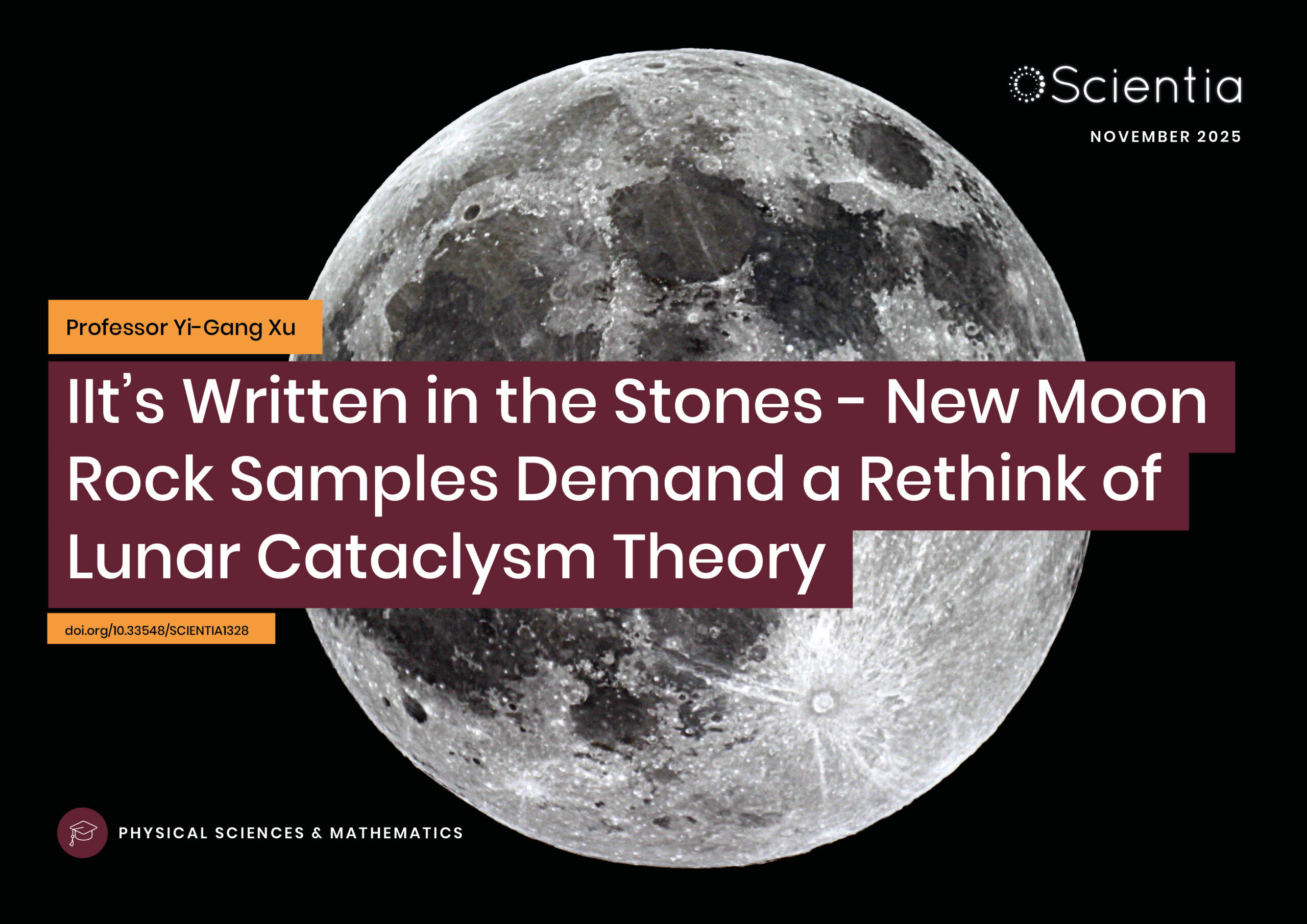
Professor Yi-Gang Xu | It’s Written in the Stones – New Moon Rock Samples Demand a Rethink of Lunar Cataclysm Theory
A significant debate continues between scholars in the astronomical community regarding the early history of our solar system. It’s been hypothesised that the solar system experienced a dramatic cataclysm a short while —in cosmological terms— after the Earth and Moon solidified. Dubbed the Late Heavy Bombardment theory, disturbances in gas giant orbits may have caused a sudden hailstorm of comets and asteroids to be hurled towards the inner planets. Lunar rock samples collected from craters during Apollo missions seemed to support the idea, but new evidence is demanding a rethink.
Professor Yi-Gang Xu and his team examined samples recovered from the Chang’e-6 mission in 2024, and they suggest a more gradual change in the frequency of asteroid impacts, rather than a sudden, violent cataclysm.