
DOI: doi.org/10.33548/Issue156.1
MORE ARTICLES YOU MAY LIKE
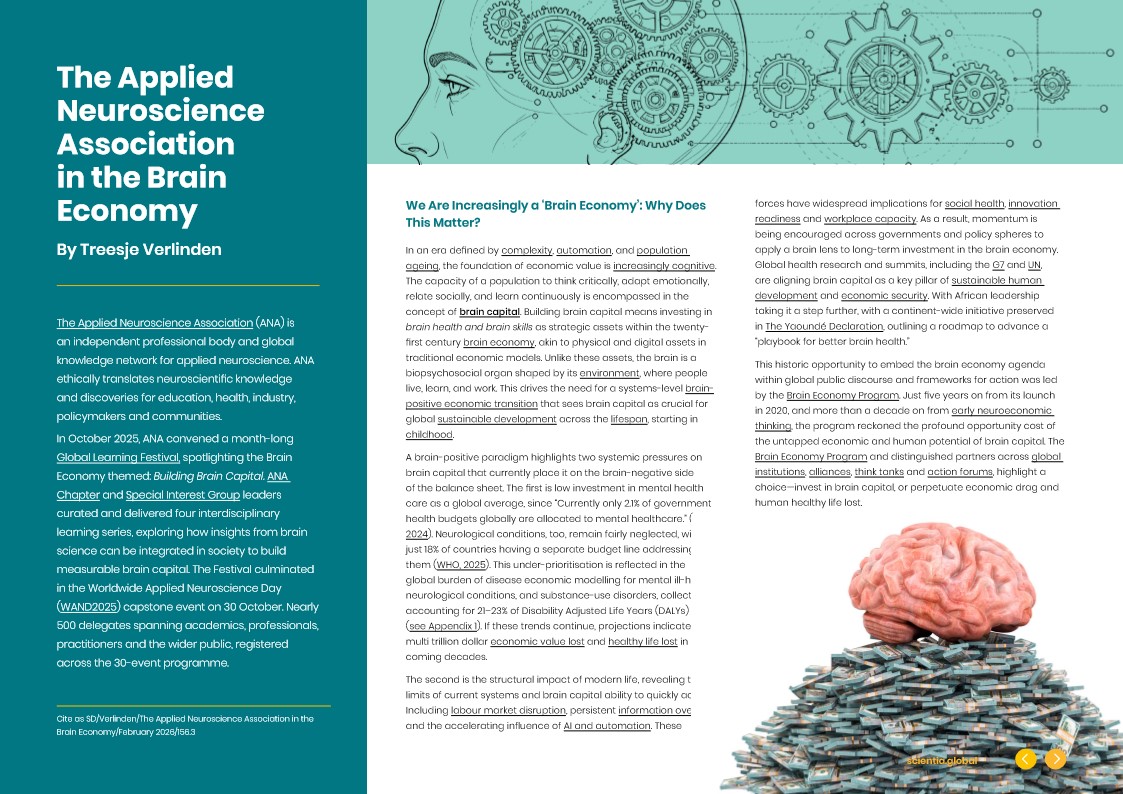
The Applied Neuroscience Association in the Brain Economy
The Applied Neuroscience Association (ANA) is an independent professional body and global knowledge network for applied neuroscience. ANA ethically translates neuroscientific knowledge and discoveries for education, health, industry, policymakers and communities.
In October 2025, ANA convened a month-long Global Learning Festival, spotlighting the Brain Economy themed: Building Brain Capital. ANA Chapter and Special Interest Group leaders curated and delivered four interdisciplinary learning series, exploring how insights from brain science can be integrated in society to build measurable brain capital. The Festival culminated in the Worldwide Applied Neuroscience Day (WAND2025) capstone event on 30 October. Nearly 500 delegates spanning academics, professionals, practitioners and the wider public, registered across the 30-event programme.

Minding our business
After explaining the concept of open impact in last issue’s editorial, we learnt about the aims of this publication.
Now, Nick answers some questions regarding the process and how we produce the articles published in Scientia.

Preprints, Trust, and DORA
The journal article has long been the object that defines academic career trajectories. In this issue, we talk to one of the main disruptors of this status quo.
Rebecca Lawrence is Vice President, Knowledge Translation at Taylor & Francis. She is also the Founding Managing Director of the open research publisher F1000 (now part of Taylor & Francis), and currently serves as Vice-Chair of DORA (San Francisco Declaration on Research Assessment).
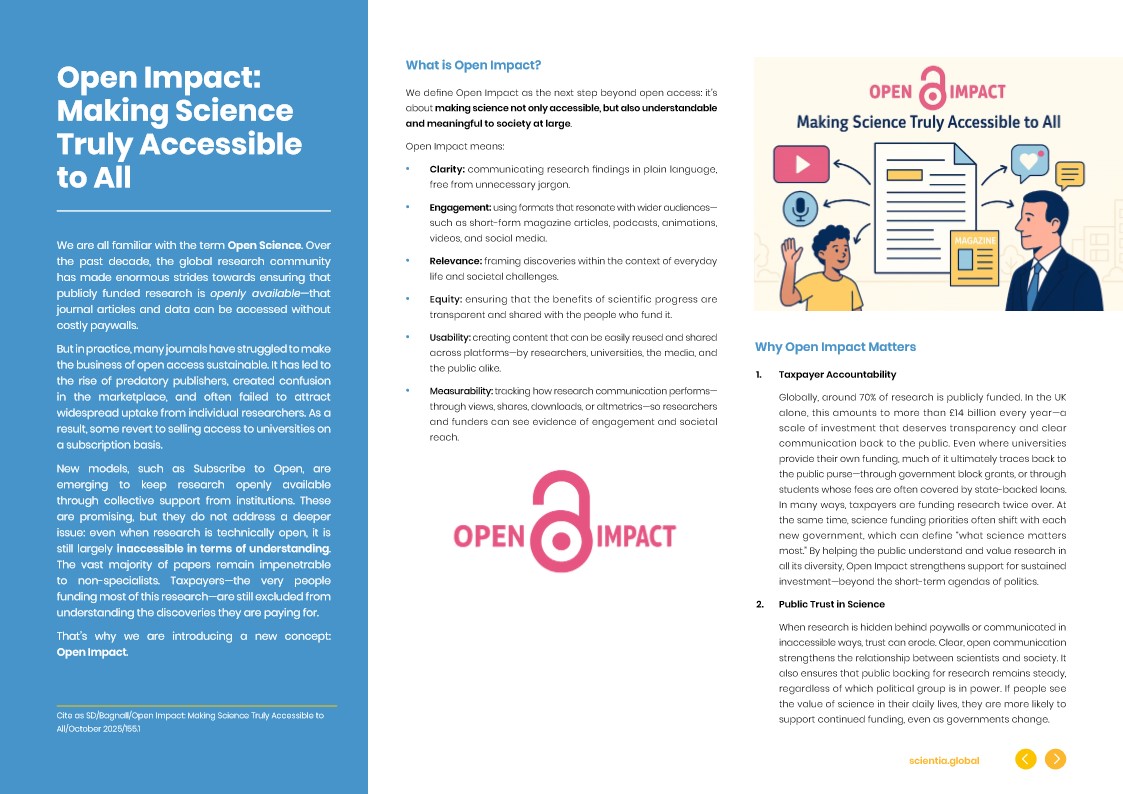
Open Impact: Making Science Truly Accessible to All
We are all familiar with the term Open Science. Over the past decade, the global research community has made enormous strides towards ensuring that publicly funded research is openly available—that journal articles and data can be accessed without costly paywalls.
But in practice, many journals have struggled to make the business of open access sustainable. It has led to the rise of predatory publishers, created confusion in the marketplace, and often failed to attract widespread uptake from individual researchers. As a result, some revert to selling access to universities on a subscription basis.