
Dr Joshua Boucher | The Fascial Distortion Model: A Clinical Tool for Musculoskeletal Pain
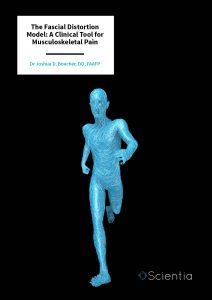
Musculoskeletal pain can be extremely debilitating and although common, it can also be difficult to treat. Dr Joshua Boucher, an osteopathic physician based at Southeast Alaska Regional Health Consortium, is working to show how the Fascial Distortion Model (FDM) can alleviate the pain and decreased function associated with musculoskeletal injuries. His encouraging findings are establishing the FDM as a useful clinical tool, and more research is already underway.
Musculoskeletal Pain and Fascia
Musculoskeletal pain can affect bones, joints, ligaments, tendons, muscles, and fascia. The causes vary from injury to long-term health conditions. Affected individuals report often persistent pain and limitations to their mobility and dexterity, impacting their ability to live a full and productive life. The World Health Organization estimates that globally, approximately 1.71 billion people suffer from musculoskeletal conditions of some form, meaning they represent a leading cause of disability.
Common musculoskeletal injuries include bone fractures, sprained ankles, and tendinopathies. The Fascial Distortion Model (FDM) by the American physician, Dr Stephen Typaldos, proposes that musculoskeletal injuries are the result of damage to fascia – the connective tissue that lies beneath the skin. This thin, stringy tissue is mostly made of collagen and wraps around each and every organ, blood vessel, bone, nerve fiber, and muscle in our bodies. When healthy, fascia provides us with the support, stability, and flexibility we need to move. But it can go wrong…
When Fascia is Damaged
The FDM describes six different fascial distortions (or diagnoses) that can occur when fascia is somehow damaged. The most common is a triggerband, in which the fascia becomes wrinkled. Herniated triggerpoint occurs when soft tissue pushes through the layers of fascia. Continuum distortion refers to the alteration of fascia between two different tissue types. In a folding distortion, the fascia has become contorted as the result of pulling or pressure such as twisting. Cylinder distortion is the term used for tangled coiling of the fascia, and finally, tectonic fixation occurs when the fascia cannot glide in its plane. Specific diagnoses are made based on how the patient describes and demonstrates their pain.
Dr Joshua Boucher, previously of the Dwight D. Eisenhower Army Medical Center, William Beaumont Army Medical Center, and now of the Southeast Alaska Regional Health Consortium, became familiar with the FDM during his medical training and quickly saw its untapped potential. He completed full training at the FDM Academy and became internationally certified through the American Fascial Distortion Model Association and now works to advance the field through research and education.
A Case Study – with Impressive Findings
In 2018, Dr Boucher published one of his early applications of the FDM in the Journal of Osteopathic Medicine in collaboration with Dr Jose Figueroa, of the Des Moines University College of Osteopathic Medicine in Iowa. This was a single case study of a patient with ‘frozen shoulder’ – so called because of the stiffness and pain that limits the individual’s range of movement. The symptoms can last for months and even years and while recovery may sometimes occur without treatment, this process is likely to be prolonged and the full range of motion may not ever be fully restored. Conventional treatment approaches include painkillers, anti-inflammatory drugs, and physiotherapy.
On encountering a 28-year-old male with frozen shoulder that had not responded to conventional self-treatment at home with medication and exercise, Dr Boucher recognized that the FDM might be an effective alternative. The pain had remained constant since the injury 18 months before, and the limitation to movement typical of the condition had progressively worsened over time, limiting the patient’s ability to conduct day-to-day tasks and even play with his children.
Osteopathic examination confirmed that the shoulder pain resulted from a hyperextension injury, in which the joint had been forced to move beyond its normal range of motion. Dr Boucher identified three fascial distortions of the shoulder: Herniated triggerpoint, triggerband, and folding distortion. Initial treatment of firm pressure using the FDM resulted in immediate benefits, with the patient reporting improved movement and reductions in pain on completion of this first intervention. He attended for a follow-up appointment two weeks later, during which Dr Boucher applied the FDM intervention again, this time resulting in the full restoration of movement and complete removal of pain. Three months later, the patient happily confirmed his complete recovery and the resumption of daily activities.
While the application of the FDM can result in temporary discomfort for both the patient and the practitioner during the manual procedure, the outcomes of this case study were certainly impressive, and confirmed the potential of the FDM as a noninvasive and alternative approach to managing musculoskeletal injuries.

Delving Deeper into Why
Encouraged by these findings and his work as a military physician in which he repeatedly saw the effectiveness of the FDM, Dr Boucher wanted to understand more about how and why the FDM could be so effective.
One condition that he frequently treated in his work was plantar heel pain, which occurs on the bottom of the foot (also known as plantar fasciitis). He discovered that it is possible to measure the thickness of the plantar fascia to track objective changes in the condition over time. Seeing that this could provide direct evidence of improvement as a result of treatment for plantar heel pain, Dr Boucher knew he could now delve deeper into the effects of the FDM.
During the intern year of his Family Medicine residency, Dr Boucher started the long and difficult process of requesting institutional review board approval to conduct this research, supported by his mentor, Dr Scott Mooney. Never in the USA had the FDM been studied on a large scale before and thus, safety data were limited – which made it difficult. But after nearly a year, the required approval was received, and the researchers started the study.
Objective Evidence of Improvement
The participants were full-time military personnel who reported heel pain for at least 30 days and also had a clinical diagnosis of plantar heel pain. Dr Boucher used the FDM diagnostic and treatment strategy to identify fascial distortions according to patient-reported pain patterns and examination. He applied the therapy at this point and again one week later with a total of 28 participants.
Once again, the results were impressive, showing significant and sustained improvement on a range of validated measures of pain and physical function. But most critically, the thickness of the plantar fascia was reduced, as assessed by ultrasound at the beginning of the study and follow-up at 16 weeks. The ultrasound was conducted by a radiologist ‘blinded’ to each participant’s status in the study, meaning the interpretation of the scans was free from any potential bias.
Although small, this study represents an important milestone for the FDM. Building on clinical observation and subjective reports of benefits from participants, this study confirmed that the benefits could be directly and objectively observed.
A Solid Foundation for Further Research and Progress
Dr Boucher isn’t stopping yet and he believes there is much more to learn about the FDM. He is currently working on two survey-based studies and notes that we still have little data on the side effects, safety, and effects of the FDM in other musculoskeletal conditions. These are important gaps to fill in the near future.
Nonetheless, the findings from Dr Boucher suggest that compared to other interventions, the FDM is relatively inexpensive, least invasive, and can lead to the fastest onset of recovery for musculoskeletal pain. Having provided a solid foundation on which to build, he is committed to advancing and pioneering FDM research further.
Having personally observed the impact that the FDM has had on his patients, Dr Boucher is working on becoming a member of the FDM Academy to help teach the FDM across the USA. You can learn more about the courses at https://afdma.com/ and https://www.thefdmacademy.com/
SHARE

DOWNLOAD E-BOOK
REFERENCE
https://doi.org/10.33548/SCIENTIA918
MEET THE RESEARCHER

Dr Joshua D. Boucher, DO, FAAFP
Southeast Alaska Regional Health Consortium
Juneau, AK
USA
Dr Joshua Boucher is an osteopathic physician based at the Southeast Alaska Regional Health Consortium. In 2012, he received a bachelor’s degree in Biology from Utah State University, and in 2016, graduated from the Osteopathic medical school Des Moines University. He was awarded a full ride scholarship to medical school through the Health Professions Scholarship Program which required him to serve four years in the United States Army after finishing his residency. In 2019, he graduated from a family medicine residency at the Dwight D. Eisenhower Army Medical Center. That same year, he became boarded in family medicine, and as Captain in the United States Army, became the Medical Director at the Soldier Family Medical Clinic at Fort Bliss Texas. Shortly after, he was assigned to be the pain champion and since then, has mentored many military providers in the Fascial Distortion Model (FDM). In 2020, he was moved into the Officer-in-Charge position where he managed a primary care clinic and that same year, was hired as an adjunct faculty member at the Burrell College of Osteopathic Medicine. He is a Director-at-Large for the American Fascial Distortion Model Association where he leads the research committee. In addition to research activities that include mentoring researchers and organizing national research competitions, he has published several peer-reviewed medical articles.
CONTACT
E: josh.d.boucher@gmail.com
W: https://afdma.com/body-map/
KEY COLLABORATORS
Dr Scott Mooney, Dwight D. Eisenhower Army Medical Center, USA
Dr Thomas Dewey, OMECO Family Medicine Residency, USA
Dr Robert G. Kirtley, Dwight D. Eisenhower Army Medical Center, USA
Dr Tyler Walker, Dwight D. Eisenhower Army Medical Center, USA
Dr David Rabago, Penn State College of Medicine, USA.
FURTHER READING
JD Boucher, T Walker, S Mooney, et al., Manual Therapy Informed by the Fascial Distortion Model for Plantar Heel Pain: A Single-Arm Prospective Effectiveness Study, Journal of Alternative and Complementary Medicine, 2021, 7(8), 697–705. DOI: https://doi.org/10.1089/acm.2020.0486
T Capistrant, G Harrer, T Pentzer, The Fascial Distortion Model: Philosophy, Principles and Clinical Application, 2021, Handspring Publishing Limited.
JD Boucher, F Figueroa, Restoration of Full Shoulder Range of Motion After Application of the Fascial Distortion Model, Journal of Osteopathic Medicine, 2018, 118(5), 341–344. https://doi.org/10.7556/jaoa.2018.044

REPUBLISH OUR ARTICLES
We encourage all formats of sharing and republishing of our articles. Whether you want to host on your website, publication or blog, we welcome this. Find out more
Creative Commons Licence (CC BY 4.0)
This work is licensed under a Creative Commons Attribution 4.0 International License. 
What does this mean?
Share: You can copy and redistribute the material in any medium or format
Adapt: You can change, and build upon the material for any purpose, even commercially.
Credit: You must give appropriate credit, provide a link to the license, and indicate if changes were made.
SUBSCRIBE NOW
Follow Us
MORE ARTICLES YOU MAY LIKE

Jean Lycke | Addressing Unmet Medical Needs in Mucosal Disease: A Close-to-Market Innovation Approach
Recurrent Aphthous Stomatitis (RAS) is an oral condition characterized by one or several painful mucosal ulcers. RAS affects a large proportion of the population and has a point prevalence of approximately 2–3%, daily. The etiology remains unknown, and there is currently no curative treatment. Most patients experience recurring episodes over time, with each episode typically lasting up to a week. Here, we describe the development of a mucoadhesive patch which, when applied over a RAS ulcer, provides rapid pain relief. The patch is easy for patients to apply when symptoms begin and has the potential to be used as an over-the-counter product. The development of the Mucocort mucoadhesive patch is an example of a Close-to-Market innovation strategy that embraces simplicity within a complex healthcare system. By simplifying the product concept, the team has reduced the number of regulatory steps required before market approval. This MedTech/Pharma innovation model, known as the “4R” framework – Re-purposing, Re-formulation, Re-positioning, and Re-patenting – has guided the program from concept to commercialization. In addition to the biodegradable mucoadhesive patch developed for RAS ulcers, the team is extending the innovation concept to a mucoadhesive gel formulation for the prevention and treatment of chemotherapy-induced mucositis. This gel-based program is being commercialized separately through MucoShield.

The Translational Asian Agerelated Macular Degeneration Program Phase 2 (TAAP-2): Reimagining the Future of Vision Care
Age-related macular degeneration, often abbreviated as AMD, is one of the leading causes of vision loss among older adults worldwide. In Asia, where populations are ageing rapidly, its impact is particularly profound. For many, the disease quietly erodes central vision, making everyday activities such as reading, driving, and recognising faces increasingly difficult. Against this backdrop, the Translational Asian Age-related Macular Degeneration Programme, or TAAP for short, has emerged as a bold and ambitious effort to confront the disease headon. Now in its second phase, TAAP-2 represents a significant evolution in both scientific scope and clinical ambition.

Ms. Aikaterini Dritsoula | Looking Beyond Snoring: How Hidden Airway Problems Shape Children’s Sleep
For many parents, a child’s snoring may seem harmless, even endearing. Yet in some cases, it signals something more serious. Obstructive sleep apnoea is a condition in which a child’s breathing is repeatedly disrupted during sleep. These interruptions can affect growth, behaviour, and learning. Children with this condition may toss and turn at night, struggle to concentrate during the day, or show signs of hyperactivity and fatigue. Traditionally, enlarged tonsils and adenoids have been seen as the main culprits. Surgery to remove them has long been considered the standard treatment. However, research led by Consultant ENT Surgeon Ms. Aikaterini Dritsoula of The Leeds Teaching Hospitals NHS Trust invites us to look deeper. Her work suggests that the story is often more complex, especially in very young children.
Professor Neil Coffee – Professor Vincent Versace | Mapping Health Access: Using Address-Level Intelligence for Smarter Services
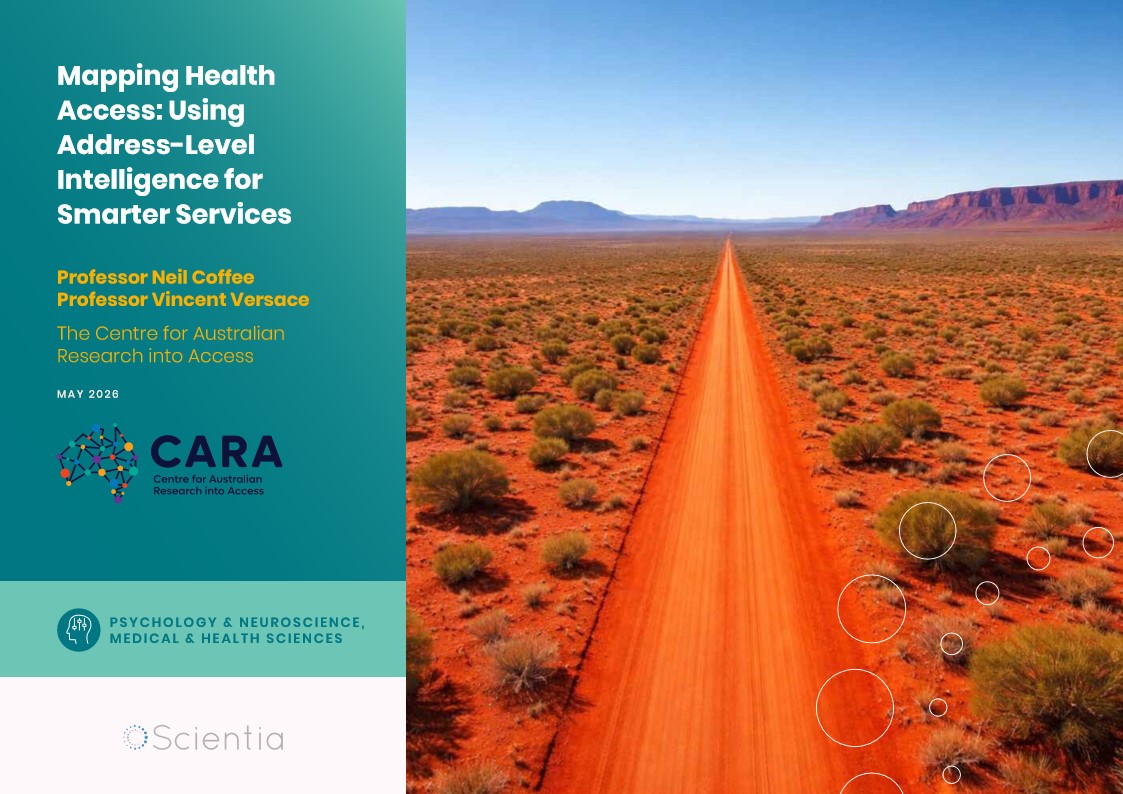
Accessing healthcare is a serious challenge for people living in rural and remote Australia. Large distances, sparse populations, and limited services can prevent residents from receiving care when they need it. Professors Neil Coffee and Vincent Versace at Deakin University’s Centre for Australian Research into Access (CARA) are leading research to model healthcare service access across the country, to provide new insights that can guide health planning and policy, as well as other services such as education. This work combines the curation of detailed address level residential dwellings and road network data to calculate access to service metrics (time and distance). These metrics are applied to the simulated residential dwelling population, to quantify the population with poor access to health services.