
Dr Susan Kennedy | Understanding Substance Abuse in College Students
Substance abuse in college students is a particular concern. Dr Susan Kennedy, Department of Psychology at Denison University in Ohio, USA, recently led a collaboration with colleagues from the Ohio State University and Kenyon College to explore alcohol and drug use in college students. More specifically, Dr Kennedy and the team wanted to identify at-risk groups and promote student well-being.
Burning the Candle at Both Ends
Student life is often associated with working late into the night for papers, other assignments, and exams, somehow balanced with a hectic social schedule involving parties and, inevitably, alcohol. The World Health Organization states that alcohol consumption causes death and disability relatively early in life, with 13.5% of the total deaths of 20–39-year-olds being attributed to alcohol. Alcohol use is also associated with a number of high-risk behaviours, such as illegal drug use and risky sexual behaviours. In particular, the nonmedical use of prescription stimulants (NMUPS) by students is on the rise.
Dr Susan Kennedy worked with her colleagues Paula Millin from the Department of Psychology at Kenyon College and Gary Kennedy from the Office of Student Academic Success at Ohio State University to investigate the relationship between self-reported invincibility, alcohol problems, and the nonmedical use of prescription stimulants. Their critical aim was to support student health and well-being.
The Invincible Student
Dr Kennedy notes that during young adulthood, deleterious behaviours are common. She adds that previous researchers have explored the factors linked to the occurrence of these types of behaviours with the hope of developing targeted interventions for those young adults most at risk. One such factor is ‘invincibility’ (often called ‘invulnerability’), which refers to the feeling of immunity from the consequences of one’s behaviour. From an earlier study, she found that the young adults who scored high on a measure of invincibility took part in riskier activities like drinking, smoking and drug use compared to those who scored lower on the scale.
Dr Kennedy states that one of the most potentially damaging behaviours observed in adolescents and young adults is heavy drinking. According to the Substance Abuse and Mental Health Services Administration in the USA, 54.9% of full-time college students (aged 18–22 years old) reported drinking in the past month, with 37% admitting to binge drinking. Dr Kennedy stresses that alcohol misuse in students is linked to significant levels of negative academic and social behaviours such as poor exam performance, missed classes because of hangovers, and physical and sexual assaults.
She goes on to explain the particular concern regarding the use of NMUPS by students. Together with alcohol, NMUPS use has become a significant health concern on campuses over the last twenty years. She adds that students typically take stimulants so they remain awake and alert for longer periods in order to study. These include methylphenidate (Ritalin), amphetamine, and dextroamphetamine (Adderall), used in the treatment of attention deficit hyperactivity disorders.
Misusing these prescription medicines can result in a myriad of unwanted health consequences, including hallucinations, paranoia, dependency and cardiac problems. She also stresses that many students believe that NMUPS will help them achieve their academic goals. Meanwhile, research shows the opposite, with NMUPS being linked with lower grades and missed classes.

Asking the Students
Dr Kennedy says that gaining a better understanding of the psychology behind these behaviours is important for educational efforts and for promoting the health of vulnerable students. Dr Kennedy and her colleagues conducted a preliminary study to explore the relationships between self-reported invincibility, alcohol use, and NMUPS. They had 175 participants who were 18 years or older (mean age was 19.37 years) who were enrolled at two Midwestern residential colleges. The participants completed questionnaires on demographics, stimulant use, a Student Alcohol Questionnaire, and an Adolescent Invincibility Tool. The responses were then analysed using structural equation modelling and various statistical methods.
Dr Kennedy and her team gathered sufficient data to test three hypotheses. They thought that there would be a direct relationship between student invincibility and alcohol use and NMUPS, with the students who perceived themselves to be more invincible experiencing more of the negative consequences of drinking and being more likely to engage with NMUPS. The team also thought that there would be gender differences on the measure of invincibility, with males reporting higher levels of invincibility and NMUPS, and also that men who were members of Greek organisations and consumed alcohol, would be more likely to engage with NMUPS.
The Next Steps
Dr Kennedy and her colleagues confirmed their ideas with the data from the questionnaires. She further explains that they found significant relationships between invincibility, alcohol-related problems, and Greek organisation membership, with males reporting higher levels of invincibility. She says their study showed that alcohol problems may be related to NMUPS, and students reporting high levels of invincibility may be at risk for NMUPS. She adds that such students might benefit from education about the potentially harmful consequences of taking these medicines without a prescription.
Dr Kennedy notes that while this study has some limitations, it opens up further avenues of research and refinement of the methodologies used. This was a small study, and Dr Kennedy adds that some of the questions may not have applied to their particular student group (for example, questions about driving under the influence).
Regardless of the limitations of the study, these preliminary data suggest that self-reported invincibility may be a useful measure to examine the engagement in potentially harmful behaviours that are often seen in students, such as NMUPS. Given that very little data on the relationship between invincibility and NMUPS can be found, this study offers valuable insights.
SHARE

DOWNLOAD E-BOOK

REFERENCE
https://doi.org/10.33548/SCIENTIA930
MEET THE RESEARCHER

Dr Susan Kennedy
Department of Psychology
Denison University
Granville, OH
USA
Dr Susan Kennedy is an Associate Professor in the Department of Psychology at Denison University, Ohio. She is also currently the Chair of Health, Exercise, and Sport Studies as well as part of the Senior Faculty, and has been a member of the Neuroscience Faculty Group since 1999. Over her academic career, she has researched, lectured, and taught at several institutions, including the Ohio State University Medical School. She has received several awards, including the PPP Award for Pedagogical Innovation in 2015 and again in 2019. In 1978, Dr Kennedy earned her BA in Psychology at Florida Atlantic University and, in 1980, her MA in Experimental Psychology. In 1985, she completed her PhD in Psychobiology and Psychopharmacology at the Ohio State University and later held a postdoctoral appointment in Behavioral Immunology there.
CONTACT
E: kennedys@denison.edu
W: https://denison.edu/people/susan-kennedy
KEY COLLABORATORS
Paula Millin, Department of Psychology, Kenyon College, Gambier, OH, USA
Gary J. Kennedy, Office of Student Academic Success, Ohio State University, Columbus, OH, USA
FURTHER READING
S Kennedy, P Millin, GJ Kennedy, A Preliminary Study Examining Self-Reported Invincibility, Alcohol Problems, and the Nonmedical Use of Prescription Stimulants in College Students, Journal of Drug Issues 2022, 52(1), 3–14, DOI: https://doi.org/10.1177/00220426211037267

REPUBLISH OUR ARTICLES
We encourage all formats of sharing and republishing of our articles. Whether you want to host on your website, publication or blog, we welcome this. Find out more
Creative Commons Licence (CC BY 4.0)
This work is licensed under a Creative Commons Attribution 4.0 International License. 
What does this mean?
Share: You can copy and redistribute the material in any medium or format
Adapt: You can change, and build upon the material for any purpose, even commercially.
Credit: You must give appropriate credit, provide a link to the license, and indicate if changes were made.
SUBSCRIBE NOW
Follow Us
MORE ARTICLES YOU MAY LIKE

Dr. Colleen Fisher | Singing to the Lions: Tackling Childhood Trauma in Zimbabwe Through Creative Psychosocial Support
Mental health challenges are one of the biggest issues facing children and adolescents across the world, particularly in low-resource settings. In Zimbabwe, a 3-day intervention called Singing to the Lions is helping young people build resilience through creative, traumainformed workshops. Dr Colleen Fisher and colleagues in Zimbabwe and the U.S. led the first formal evaluation of the intervention, offering new insight into how locally grounded intervention approaches can support youth mental health at scale.

Assoc Prof. Nicholas Brown | Rethinking Prostate Care: A New Frontier in Treating Benign Prostatic Hyperplasia
For millions of men, ageing brings with it a set of frustrating and often disruptive urinary symptoms. These symptoms, caused by benign prostatic hyperplasia, or BPH, can affect sleep, confidence, and overall quality of life. Traditionally, treatment follows a familiar path. Patients begin with medications, often for years, and may eventually progress to surgery if symptoms worsen. Yet this pathway is not without its drawbacks. Medications can cause side effects, while surgery carries risks and recovery time. In recent years, a minimally invasive interventional radiology procedure called prostate artery embolisation, or PAE, has begun to challenge this traditional model. At the forefront of this shift is a collaborative research group, led by Dr. Nicholas Brown of the University of Queensland, whose series of P-EASY studies has explored whether PAE could transform how BPH is treated, particularly at earlier stages.

Jean Lycke | Addressing Unmet Medical Needs in Mucosal Disease: A Close-to-Market Innovation Approach
Recurrent Aphthous Stomatitis (RAS) is an oral condition characterized by one or several painful mucosal ulcers. RAS affects a large proportion of the population and has a point prevalence of approximately 2–3%, daily. The etiology remains unknown, and there is currently no curative treatment. Most patients experience recurring episodes over time, with each episode typically lasting up to a week. Here, we describe the development of a mucoadhesive patch which, when applied over a RAS ulcer, provides rapid pain relief. The patch is easy for patients to apply when symptoms begin and has the potential to be used as an over-the-counter product. The development of the Mucocort mucoadhesive patch is an example of a Close-to-Market innovation strategy that embraces simplicity within a complex healthcare system. By simplifying the product concept, the team has reduced the number of regulatory steps required before market approval. This MedTech/Pharma innovation model, known as the “4R” framework – Re-purposing, Re-formulation, Re-positioning, and Re-patenting – has guided the program from concept to commercialization. In addition to the biodegradable mucoadhesive patch developed for RAS ulcers, the team is extending the innovation concept to a mucoadhesive gel formulation for the prevention and treatment of chemotherapy-induced mucositis. This gel-based program is being commercialized separately through MucoShield.
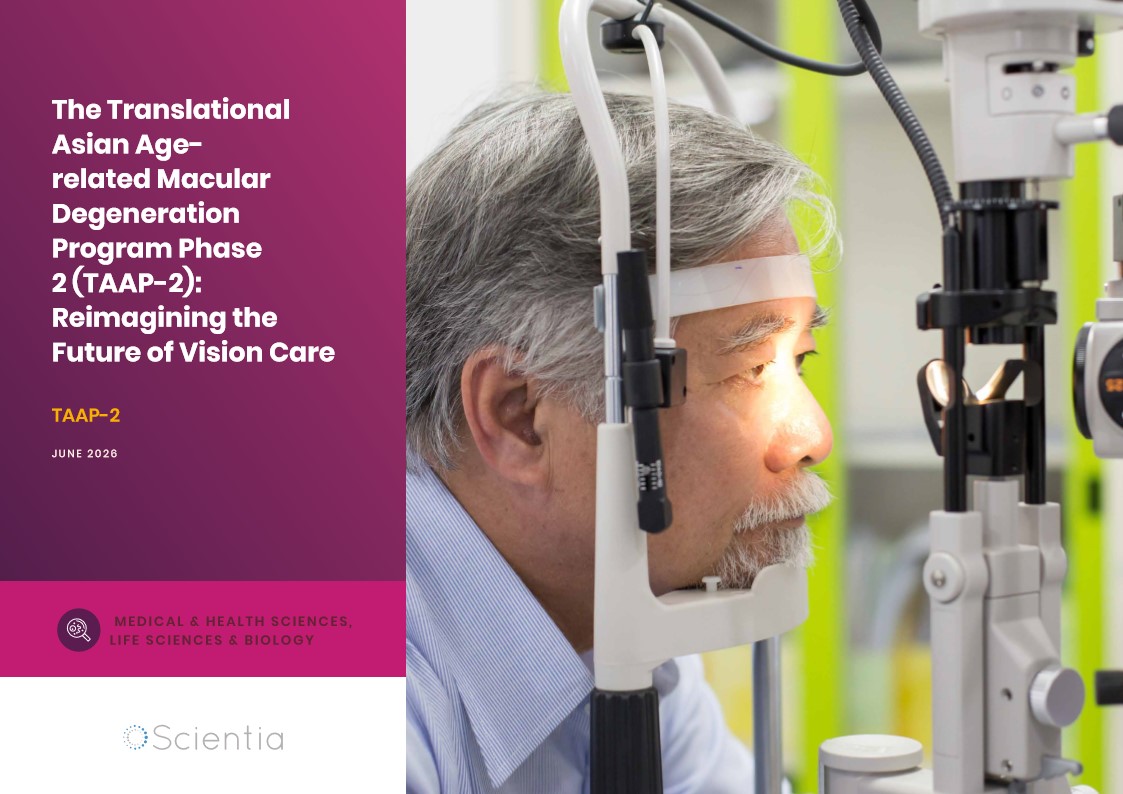
The Translational Asian Agerelated Macular Degeneration Program Phase 2 (TAAP-2): Reimagining the Future of Vision Care
Age-related macular degeneration, often abbreviated as AMD, is one of the leading causes of vision loss among older adults worldwide. In Asia, where populations are ageing rapidly, its impact is particularly profound. For many, the disease quietly erodes central vision, making everyday activities such as reading, driving, and recognising faces increasingly difficult. Against this backdrop, the Translational Asian Age-related Macular Degeneration Programme, or TAAP for short, has emerged as a bold and ambitious effort to confront the disease headon. Now in its second phase, TAAP-2 represents a significant evolution in both scientific scope and clinical ambition.