
Evaluating Age-Related Macular Degeneration Outcomes with Novel Therapies
Age-related macular degeneration (AMD) is a global health concern which can severely impact the quality of life(QoL) of patients. Extensive research has focussed on managing AMD, but there is a marked disparity in the treatment outcomes achieved in stringently controlled clinical trials and real-world settings. Members of the Translational Asian Age-related Macular Degeneration Program (TAAP) at the Singapore Eye Research Institute are continuing their vital work investigating the impact of different treatment regimens on patient outcomes.
Current Treatments and Outcomes
AMD is characterised by bleeding, swelling, and fluid accumulation in the retina, which can lead to permanent vision loss. Prior to permanent vision loss, a patient’s quality of life (QoL) deteriorates as eyesight gradually worsens, thus impacting mobility and emotional well-being. Evidence-based medicine using methodologically sound research procedures can help to inform optimal treatment planning. Although extensive clinical trials have been conducted during the past decade, the findings are often not reproducible in real-world medicine. Moreover, there is a paucity of published evidence relating to AMD in non-Western populations. This is a critical omission since the prevalence and incidence of AMD subtypes differs across geographical regions; in Europe and America, the most common form of AMD is choroidal neovascularisation (CNV), but in Asia, polypoidal choroidal vasculopathy (PCV) predominates.
Injections of vascular endothelial growth factor (VEGF) inhibitors are a well-established therapeutic intervention for AMD. However, traditionally, these have been strictly administered monthly, which is inconvenient and exacerbates financial pressures, leading to non-compliance and disease progression. There is a growing trend for implementing more flexible administration schedules to reduce dosing frequency and clinic attendance while maintaining favourable patient outcomes. Therefore, by monitoring and analysing the outcomes achieved during real-world clinical practice in Singapore, a more accurate insight into how specific treatments and schedules may pan out in ageing Asian communities can be achieved.
In recent years, the researchers and clinicians forming the Translational Asian Age-related Macular Degeneration Program (TAAP) at the Singapore Eye Research Institute, along with colleagues at various renowned Institutes and Universities around the world, have been conducting cutting-edge research into AMD in Asians of advancing age. The main aims of their studies have been to evaluate the most appropriate drug regimens and the optimal interval between treatments, depending upon the disease type and disease activity, using real-world data and bio-imaging techniques. Moreover, in TAAP’s efforts to better understand the impact of AMD on QoL in Asia and the effectiveness of AMD clinical management from the perspective of patients, a state-of-the-art AMD-specific computerised adaptive system is being developed and validated.
Credit: TAAP
Enhancing Outcomes with Adjunct Treatments
The work undertaken by the TAAP group has been introduced in an earlier article. The objectives of their studies at the time of publication were to elucidate disease mechanisms, develop novel, sophisticated diagnostic technologies, optimise treatments, and increase understanding of the impact of AMD on those experiencing the condition to help improve patient outcomes.
The cornerstone of the TAAP team’s research is accumulating real-world evidence. Recently, the team conducted a study comparing the outcomes of first-time AMD-CNV and AMD-PCV treatments in Asian patients using either traditional anti-VEGF monotherapy alone or in adjunct with photodynamic therapy (PDT).
Existing data in which detailed baseline measurements taken before treatment commenced were used by the team. Initial treatments and scheduled re-treatments had been tailored according to individual clinical characteristics, which is the recommended approach for optimal outcomes.
The frequency of injections received during the first 12 months of treatment was a good predictor of visual improvement. Greater improvements in visual acuity were found for patients who received between 4–7 injections compared to those who received fewer injections. Whilst treating AMD-CNV with anti-VEGF in this study was comparable to other real-world studies in Western countries, outcomes were not as successful as in clinical trials. However, using combination therapy for AMD-PCV patients yielded improvements in vision comparable to those achieved in controlled trials – an outcome virtually unheard of previously.
The Importance of Timing
Having determined the impact of the number of injections administered over a set period on visual improvement in AMD, Dr Teo’s team turned their attention to the ramifications of extended intervals between injections in patients with active neovascular disease. Delayed treatment was defined as missing injections at two or more assessment appointments in 12 months when active disease was observed, whilst timely re-treatment was defined as receiving treatment when the disease was active.
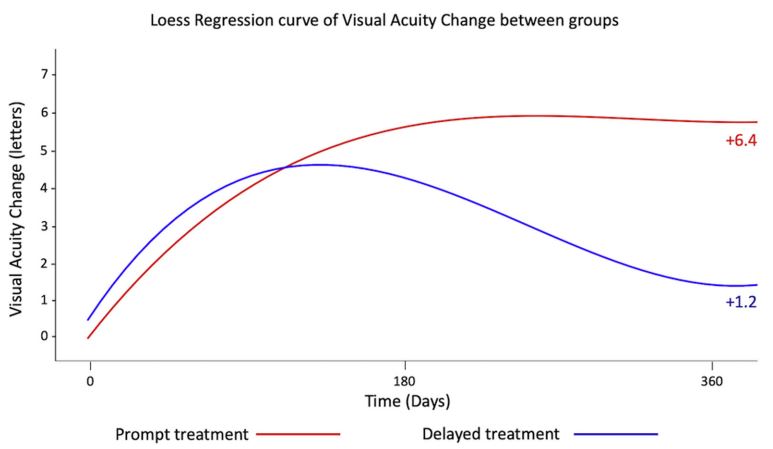
The team found that patients whose active disease was not managed promptly had significantly reduced visual gains than those treated in a more timely manner, and that any gain in visual function upon initiation of treatment was lost. Furthermore, patients treated more promptly attended a significantly higher number of assessment appointments, corresponding with closer monitoring of the disease state. The increased number of assessment appointments was also associated with shorter intervals between treatments, which improved visual acuity during the 12-month period compared to delayed re-treatment following the reactivation of disease.
This novel finding confirmed that, regardless of the number of injections received over the treatment period, a longer interval between injections in patients with active AMD has a significant deleterious effect on clinical outcomes. The team concurred that a bespoke treatment regime that considers individual disease patterns and accounts for the temporal nature of disease activity may be more important than the actual number of injections received, and that acting immediately upon detection of active disease will assist in optimising treatment schedules and informing best clinical practice.
Credit: TAAP
Mitigating the Impact of Unintentional Delays
Expanding on these findings, the team analysed a large patient data set to investigate the impact of unintentional deviations from planned treatment schedules in the context of clinical adjustments necessitated by the recent COVID-19 pandemic. Dr Teo’s team found that there was a significant loss in visual acuity and, therefore, a risk to salvageable vision when the interval between injections was extended to 12 weeks and longer in patients with active disease compared to treatment intervals of 6 weeks or less over a period of six months. However, the team also noted that vision can remain relatively stable for up to six months, even at 10–12-week injection intervals. Although the analysis was conducted on data obtained previously, the study was useful in assisting clinicians in treatment planning during the unprecedented COVID-19 pandemic.
Of course, whilst the findings are valid in the event of a similar crisis in the future, they are also applicable to unexpected treatment schedule deviations in real-world medicine in regular circumstances, which may be caused by extended hospital stays, periods of illness, fear of treatment, or patient non-compliance due to poor understanding of associated consequences.
Developing a Novel Quality of Life Evaluation Tool
Whilst current treatments for AMD undoubtedly improve clinical outcomes such as visual acuity, the impact of treatments from the patient’s perspective is comparatively less well understood. As such, it is imperative that the patient is involved in planning future therapeutic approaches. Collecting quantitative patient-reported data has traditionally been achieved using questionnaires. However, these are often lengthy and may be burdensome to complete. Moreover, in the case of ‘paper-pencil’ questionnaires, data entry and scoring must be done manually, and real-time reporting is not possible.
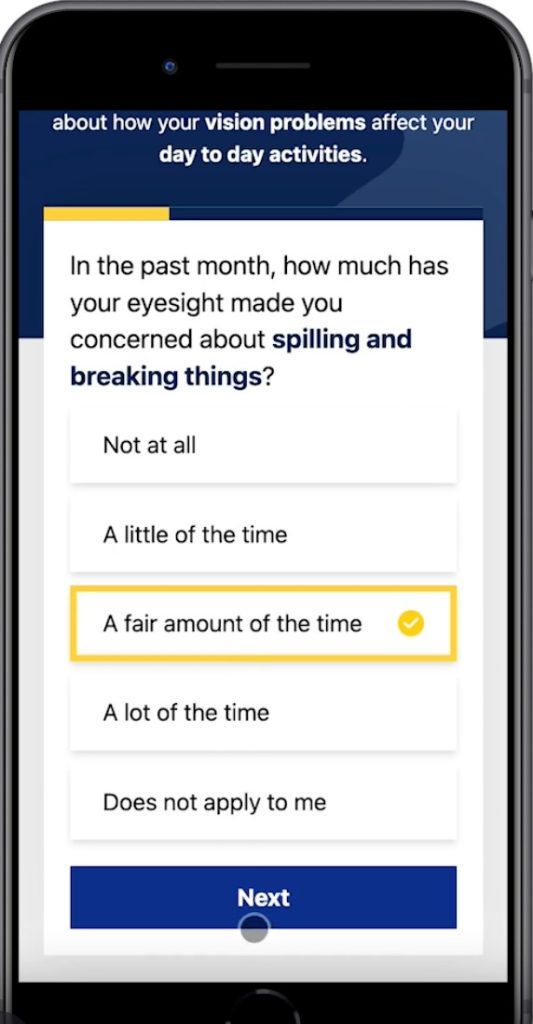
To overcome these issues, item banking (IB) and computerised adaptive testing (CAT) can be used to obtain accurate estimations of a range of QoL constructs (e.g. activity limitation, mobility, emotional well-being, concerns, AMD management). IBs comprise a large bank of items, calibrated in terms of relative difficulty like a ruler, that are administered using a CAT algorithm that is based on artificial intelligence. The CAT selects items from the bank that most closely target the person’s QoL at that point in the test. This ‘smart technology’ means that precise estimates of each QoL construct can be obtained using very few items. Importantly, as each QoL item bank functions independently, users can select relevant domains for their sample population (e.g., the AMD Management domain may be more relevant to patients on treatment), and this feature makes it very useful in optimising treatment plans for patients alongside the standard clinical and imaging data.
Professor Ecosse Lamoureux and A/Prof Eva Fenwick are currently working on the development of an IB/CAT system (MacCAT) to specifically assess QoL in AMD patients. While the MacCAT is being developed in Singapore, its content was derived from both interviews with Singaporean patients with AMD/PCV and currently available literature on the QoL impact of AMD in Western and other populations, meaning it has global applicability. The pilot version of MacCAT has been tested in a large patient cohort from which calibrations for the item bank have been calculated. CATs covering six domains of QoL have been built on the team’s secure, cloud-based platform, and the performance of the CATs is currently being evaluated in another large clinical sample. Undoubtedly, this innovative system will pave the way for a more refined method for holistically measuring the impact of AMD on QoL, leading to improved monitoring of patient well-being, bespoke treatments, and an increase in desired clinical outcomes.
Certainly, the TAAP team of researchers have exceeded their goals thus far. They will unquestionably achieve their ultimate goal of removing the barriers to effective treatment and improving the lives of individuals with this debilitating condition.
SHARE

DOWNLOAD E-BOOK
REFERENCE
https://doi.org/10.33548/SCIENTIA1009
MEET THE RESEARCHER

Associate Professor Kelvin Teo
Singapore National Eye Centre
Singapore
Associate Professor Kelvin Teo is a senior consultant at the Singapore National Eye Centre and has a strong interest in clinical research in the field of medical retina. In particular, his focus is on real-world outcomes and how imaging techniques help to advance the pathophysiology and therapy of neovascular age-related macular degeneration.

Professor Ecosse Lamoureux
Duke-NUS Medical School
Singapore
Professor Ecosse Lamoureux is a tenured Professor at Duke-NUS Medical School. He undertakes his clinical research at the Singapore Eye Research Institute, where he is the Director of the Population Research and Clinical Epidemiology platform. His contribution to population eye health research is significant. He leads the patient-reported outcomes research component of the Singapore Epidemiology of Eye Diseases programme. He has contributed significantly to a better understanding of the economic, social and personal burden and considerable impact of vision impairment and ocular pathologies in Singapore and Asia. His recent work includes a large population-based study to understand better the burden and complex mechanisms underlying age-related sensory decline in Singapore.
CONTACT
FUNDING
Singapore National Medical Research Council Open Fund Large Collaborative Grant: NMRC/LCG/004/2018
FURTHER READING
- KY Chong Teo, V Nguyen, CM Gemmy Cheung, et al., The Impact of Disease Activity on 5-year Outcomes in Patients Undergoing Treatment for Neovascular Age-Related Macular Degeneration, Retina, 2022, 42(1), 95–106. DOI: https://doi.org/10.1097/IAE.0000000000003267
- EK Fenwick, EPX Lee, REK Man, et al., Identifying the content for an item bank and computerized adaptive testing system to measure the impact of age-related macular degeneration on health-related quality of life, Quality of Life Research, 2022, 31(4), 1237–1246. DOI: https://doi.org/10.1007/s11136-021-02989-w
- REK Man, ATL Gan, EK Fenwick, et al., Impact of Incident Age-related Macular Degeneration and Associated Vision Loss on Vision-Related Quality of Life, British Journal of Ophthalmology, 2021, 106(8), 1063-1068. DOI: https://doi.org/10.1136/bjophthalmol-2020-318269
- KY Chong Teo et al., Patterns and Characteristics of a Real-World Implementation of a Self-Monitoring Program for Retina Diseases during COVID-19 Pandemic, Ophthalmology Retina, 2021, S2468-6530(21)00055-5). DOI: https://doi.org/10.1016/j.oret.2021.02.005
- KY Chong Teo, N Saxena, A Gan, et al., Detrimental Effect of Delayed Re-treatment of Active Disease on Outcomes in Neovascular Age-Related Macular Degeneration: The RAMPS Study, Ophthalmology Retina, 2020, 4(9), 871–880. DOI: https://doi.org/10.1016/j.oret.2020.03.017
- EK Fenwick, CMG Cheung, PG Ong, et al., The impact of neovascular age-related macular degeneration and polypoidal choroidal vasculopathy on vision-related quality of life in Asian patients, British Journal of Ophthalmology, 2017, 101(5), 591–596. DOI: https://doi.org/10.1136/bjophthalmol-2016-308541
REPUBLISH OUR ARTICLES
We encourage all formats of sharing and republishing of our articles. Whether you want to host on your website, publication or blog, we welcome this. Find out more
Creative Commons Licence (CC BY 4.0)
This work is licensed under a Creative Commons Attribution 4.0 International License. 
What does this mean?
Share: You can copy and redistribute the material in any medium or format
Adapt: You can change, and build upon the material for any purpose, even commercially.
Credit: You must give appropriate credit, provide a link to the license, and indicate if changes were made.
SUBSCRIBE NOW
Follow Us
MORE ARTICLES YOU MAY LIKE

Assoc Prof. Nicholas Brown | Rethinking Prostate Care: A New Frontier in Treating Benign Prostatic Hyperplasia
For millions of men, ageing brings with it a set of frustrating and often disruptive urinary symptoms. These symptoms, caused by benign prostatic hyperplasia, or BPH, can affect sleep, confidence, and overall quality of life. Traditionally, treatment follows a familiar path. Patients begin with medications, often for years, and may eventually progress to surgery if symptoms worsen. Yet this pathway is not without its drawbacks. Medications can cause side effects, while surgery carries risks and recovery time. In recent years, a minimally invasive interventional radiology procedure called prostate artery embolisation, or PAE, has begun to challenge this traditional model. At the forefront of this shift is a collaborative research group, led by Dr. Nicholas Brown of the University of Queensland, whose series of P-EASY studies has explored whether PAE could transform how BPH is treated, particularly at earlier stages.

Jean Lycke | Addressing Unmet Medical Needs in Mucosal Disease: A Close-to-Market Innovation Approach
Recurrent Aphthous Stomatitis (RAS) is an oral condition characterized by one or several painful mucosal ulcers. RAS affects a large proportion of the population and has a point prevalence of approximately 2–3%, daily. The etiology remains unknown, and there is currently no curative treatment. Most patients experience recurring episodes over time, with each episode typically lasting up to a week. Here, we describe the development of a mucoadhesive patch which, when applied over a RAS ulcer, provides rapid pain relief. The patch is easy for patients to apply when symptoms begin and has the potential to be used as an over-the-counter product. The development of the Mucocort mucoadhesive patch is an example of a Close-to-Market innovation strategy that embraces simplicity within a complex healthcare system. By simplifying the product concept, the team has reduced the number of regulatory steps required before market approval. This MedTech/Pharma innovation model, known as the “4R” framework – Re-purposing, Re-formulation, Re-positioning, and Re-patenting – has guided the program from concept to commercialization. In addition to the biodegradable mucoadhesive patch developed for RAS ulcers, the team is extending the innovation concept to a mucoadhesive gel formulation for the prevention and treatment of chemotherapy-induced mucositis. This gel-based program is being commercialized separately through MucoShield.
The Translational Asian Agerelated Macular Degeneration Program Phase 2 (TAAP-2): Reimagining the Future of Vision Care
Age-related macular degeneration, often abbreviated as AMD, is one of the leading causes of vision loss among older adults worldwide. In Asia, where populations are ageing rapidly, its impact is particularly profound. For many, the disease quietly erodes central vision, making everyday activities such as reading, driving, and recognising faces increasingly difficult. Against this backdrop, the Translational Asian Age-related Macular Degeneration Programme, or TAAP for short, has emerged as a bold and ambitious effort to confront the disease headon. Now in its second phase, TAAP-2 represents a significant evolution in both scientific scope and clinical ambition.

Ms. Aikaterini Dritsoula | Looking Beyond Snoring: How Hidden Airway Problems Shape Children’s Sleep
For many parents, a child’s snoring may seem harmless, even endearing. Yet in some cases, it signals something more serious. Obstructive sleep apnoea is a condition in which a child’s breathing is repeatedly disrupted during sleep. These interruptions can affect growth, behaviour, and learning. Children with this condition may toss and turn at night, struggle to concentrate during the day, or show signs of hyperactivity and fatigue. Traditionally, enlarged tonsils and adenoids have been seen as the main culprits. Surgery to remove them has long been considered the standard treatment. However, research led by Consultant ENT Surgeon Ms. Aikaterini Dritsoula of The Leeds Teaching Hospitals NHS Trust invites us to look deeper. Her work suggests that the story is often more complex, especially in very young children.