
Scientists have a growing body of data that could bring them a step closer to being able to ‘instruct’ skin collagen to resist the effects of ageing, according to a review of the latest research undertaken by Dr Peter Kim, biochemist and founder of private tuition company Veribera.
The importance of collagen
Collagen is a protein that has many important functions throughout the body. One important site of collagen production is in the skin, where it contributes to skin structure, giving youthful skin its firmness, fine texture, and spring.
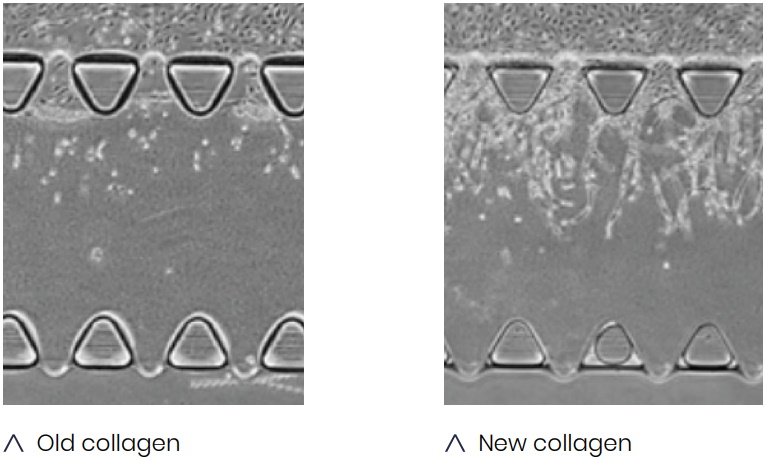
Youthful looking skin is the result of a high proportion of two specific types of collagens, called type I and III collagens. They are arranged in rodlike structures called fibrils with a specific spacing called D‑periodicity.

Ageing and collagen production
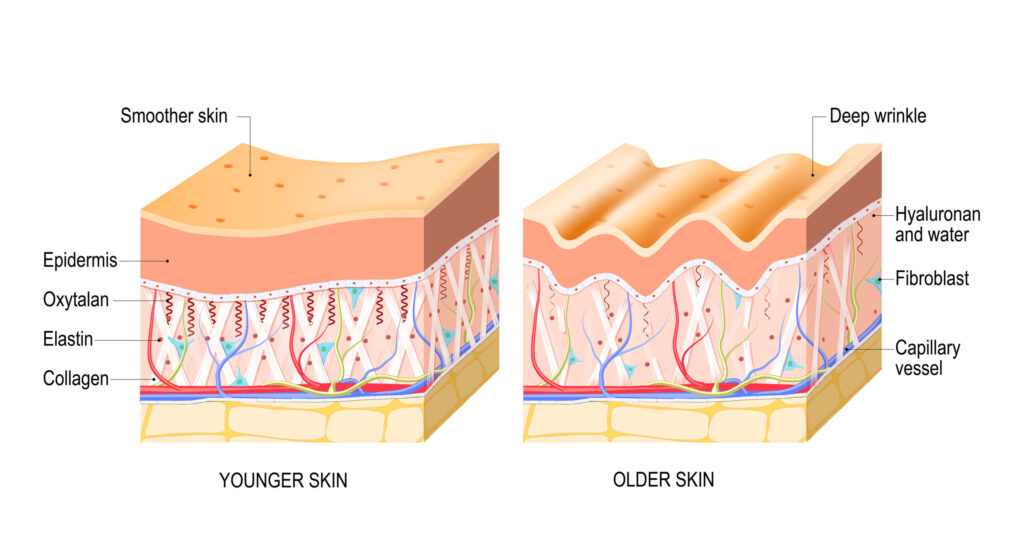
Ageing is known to adversely affect collagen in the skin, leading to sagging and wrinkling. Ageing does this in several ways: by causing poorly organised collagen, by reducing the ability of the cells to respond to collagen production cues, and by reducing the amount of collagen produced. Ultraviolet (UV) light and inflammatory enzymes (collagenases) can also fragment existing collagen.
The reason for these changes during ageing centres around the activity of a group of transmembrane proteins on the cell surface, called integrins, which recruit collagens around cells. Certain integrins, such as α1β1, α2β1, α10β1, α11β1 and β1‑integrins, bind to specific parts of collagens, called triple-helical motifs (such as GFOGER and GLOGEN). The ageing skin produces fewer β1‑integrins, resulting in the production of poorer quality collagen.
Current collagen anti-ageing treatments
Many existing anti-ageing treatments —such as vitamin C, laser treatment, microneedle treatment, and retinoids— are known to boost collagen production. Studies on oral collagen have also revealed modest improvements in elasticity, hydration, and wrinkle scores. However, existing treatments tend to focus on the quantity, rather than the quality, of collagen production.
Not all collagens are created equal
The quality of the collagen produced is determined by the exact type of amino acid in the triple-helical motif, its orientation in space (called stereochemistry), and its affinity to the integrins. This process can be ‘tuned’ by varying the chemical structure of the collagen triple-helices. Dr Kim evaluated the latest research with the aim to identify possible ways of improving the quality of collagen, to make it better-organised, hydrated, and stronger.
It is important to get the amount of binding between integrins and triple-helical collagen motifs just right. Scientists call this the ‘Goldilocks Zone’. If there is too little binding between collagen and integrins, there is insufficient tension to exert the anti-ageing effect. If there is too much binding, especially under UV light or during inflammation, a stress response is triggered which could be detrimental to the skin structure.
The type of integrin and the specific collagen triple-helical motif also affect the quality of collagen structure produced. While binding to the α2 integrin tends to reinforce robust adhesion within collagen I/III, binding to the α1 integrin can favour subtler adhesion of collagen IV. Binding to the α11β1 integrin affects collagen reorganisation. Binding of α2β1 integrins to GFOGER collagen triple-helical motifs support firm collagen adhesion and fibril alignment, whereas binding of α1β1 integrins to GLOGEN/GROGER collagen triple-helical motifs reduces over‑contraction of collagen and over enlargement. Binding of integrins to collagen GVMGFO triple-helical motifs may reduce the risk of fibrous collagen production and ensure adhesion of collagens occurs in the correct location.
The role of collagen and blood vessels in ageing
Healthy and youthful-looking skin also needs to have a sustained blood supply from resilient blood vessels to ensure effective collagen repair, efficient immunity, hydration, and supply of nutrients. Development of blood vessels, called angiogenesis, also partly relies on collagen production. This often requires binding between collagens, especially collagen I, and α1β1/α2β1 integrins.
If the right collagens with the right triple-helical motifs are in the right place at the right time to bind to the right integrins, scientists believe that this could improve collagen structure.
Collagen Toolkits have been developed with this aim. They are comprehensive libraries of engineered peptides containing triple‑helical motifs derived from natural collagens II and III.
Collagen Toolkits
Using the Collagen Toolkits, researchers are planning on testing collagen triple-helical motifs as anti-ageing treatments with the aim of orchestrating collagen production.
The collagen triple-helical motifs need to be formulated within an appropriate vehicle to transport them to the correct site of action within the skin. With this in mind, various delivery systems have been proposed, such as electrospun fibres (which are produced by applying electricity to fluids), hydrogels, or nanoparticles. The triple-helical motifs could also be formulated within carriers, called elastosomes or liposomes. Similarly, the electrical field around the triple-helical motifs could be modified (called electrostatic cloaking) to reduce incorrect binding to integrins.
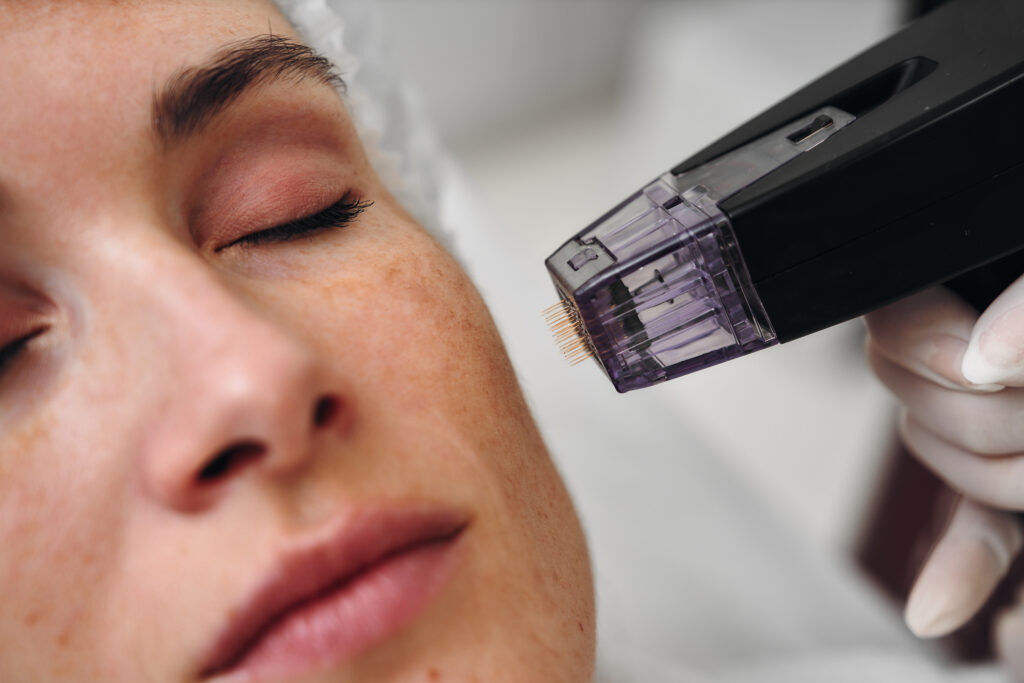
Laser or microneedle treatment is already used to boost collagen production. Scientists are now investigating whether applying a triple‑helical motif‑bearing hydrogel/serum immediately after laser or microneedle treatment could improve the quality as well as the quantity of the newly produced collagen. Research is also underway into whether microneedle patches with embedded collagen triple-helices in hyaluronic acid matrices could be a means of transporting the triple-helices into the skin with minimal trauma and reproducible dosing. For this, the patches would need to be thermally stable and the triple-helical motifs would need to be resistant to breakdown.
Other possible vehicles are dressings containing collagen triple-helices, which could be used after procedures to accelerate wound closure and healing, and wick wound exudate. Finally, effectiveness of the treatments can be measured using assessment of the integrity of the skin barrier, biopsies, microscopy, scans, and using special equipment to measure skin elasticity and firmness.
Research into anti-ageing formulations
This is a growing area of research with some promising initial studies. However, further research is needed before an anti-ageing treatment can be developed and tested, as there are still potential hurdles that scientists need to overcome. For instance, it is important that formulations minimise the entry of triple-helical motifs into the bloodstream, to reduce the risk of unwanted side effects. Binding of sugar molecules can also affect collagen mechanics, blunt healthy feedback mechanisms, stiffen collagen and potentially desensitise integrins or channel them into pathologic pathways. Scientists will also need to be careful to avoid activation of closely-related cellular pathways affecting platelets, which could impact blood clotting mechanisms.
Additional future research areas could include orchestrating the timing of binding between integrins and collagen triple-helices, or exploring synergy with other receptors. These discoveries could also pave the way for future research into using scaffolds decorated with the GFOGER triple-helical motifs, to support bone growth and blood vessel formation.
SHARE

DOWNLOAD E-BOOK

REFERENCE
https://doi.org/10.33548/SCIENTIA1326
MEET THE RESEARCHER

Dr Peter Sung Kyu Kim
Veribera, Cambridge, United Kingdom
Dr Peter Sung Kyu Kim obtained his PhD in biochemistry from the University of Cambridge in 2015, specialising in interactions between collagen and cells, the role of cell transmembrane proteins, and the biology of the matrix between cells. After gaining experiences of teaching in private schools in London and as private tutor, he founded the private tuition company Veribera, teaching sciences to all ages with the goal of making complex concepts clear, engaging, and transformative.
CONTACT
FURTHER READING
Kim, P. From Triple Helices to Timeless Skin: Collagen Toolkit Peptides and Integrin Mediated Renewal. International Journal of Current Science (IJCSPUB). Volume 15, Issue 3, 2025.
REPUBLISH OUR ARTICLES
We encourage all formats of sharing and republishing of our articles. Whether you want to host on your website, publication or blog, we welcome this. Find out more
Creative Commons Licence (CC BY 4.0)
This work is licensed under a Creative Commons Attribution 4.0 International License. 
What does this mean?
Share: You can copy and redistribute the material in any medium or format
Adapt: You can change, and build upon the material for any purpose, even commercially.
Credit: You must give appropriate credit, provide a link to the license, and indicate if changes were made.
SUBSCRIBE NOW
Follow Us
MORE ARTICLES YOU MAY LIKE

Assoc Prof. Nicholas Brown | Rethinking Prostate Care: A New Frontier in Treating Benign Prostatic Hyperplasia
For millions of men, ageing brings with it a set of frustrating and often disruptive urinary symptoms. These symptoms, caused by benign prostatic hyperplasia, or BPH, can affect sleep, confidence, and overall quality of life. Traditionally, treatment follows a familiar path. Patients begin with medications, often for years, and may eventually progress to surgery if symptoms worsen. Yet this pathway is not without its drawbacks. Medications can cause side effects, while surgery carries risks and recovery time. In recent years, a minimally invasive interventional radiology procedure called prostate artery embolisation, or PAE, has begun to challenge this traditional model. At the forefront of this shift is a collaborative research group, led by Dr. Nicholas Brown of the University of Queensland, whose series of P-EASY studies has explored whether PAE could transform how BPH is treated, particularly at earlier stages.

Jean Lycke | Addressing Unmet Medical Needs in Mucosal Disease: A Close-to-Market Innovation Approach
Recurrent Aphthous Stomatitis (RAS) is an oral condition characterized by one or several painful mucosal ulcers. RAS affects a large proportion of the population and has a point prevalence of approximately 2–3%, daily. The etiology remains unknown, and there is currently no curative treatment. Most patients experience recurring episodes over time, with each episode typically lasting up to a week. Here, we describe the development of a mucoadhesive patch which, when applied over a RAS ulcer, provides rapid pain relief. The patch is easy for patients to apply when symptoms begin and has the potential to be used as an over-the-counter product. The development of the Mucocort mucoadhesive patch is an example of a Close-to-Market innovation strategy that embraces simplicity within a complex healthcare system. By simplifying the product concept, the team has reduced the number of regulatory steps required before market approval. This MedTech/Pharma innovation model, known as the “4R” framework – Re-purposing, Re-formulation, Re-positioning, and Re-patenting – has guided the program from concept to commercialization. In addition to the biodegradable mucoadhesive patch developed for RAS ulcers, the team is extending the innovation concept to a mucoadhesive gel formulation for the prevention and treatment of chemotherapy-induced mucositis. This gel-based program is being commercialized separately through MucoShield.
The Translational Asian Agerelated Macular Degeneration Program Phase 2 (TAAP-2): Reimagining the Future of Vision Care
Age-related macular degeneration, often abbreviated as AMD, is one of the leading causes of vision loss among older adults worldwide. In Asia, where populations are ageing rapidly, its impact is particularly profound. For many, the disease quietly erodes central vision, making everyday activities such as reading, driving, and recognising faces increasingly difficult. Against this backdrop, the Translational Asian Age-related Macular Degeneration Programme, or TAAP for short, has emerged as a bold and ambitious effort to confront the disease headon. Now in its second phase, TAAP-2 represents a significant evolution in both scientific scope and clinical ambition.
Ms. Aikaterini Dritsoula | Looking Beyond Snoring: How Hidden Airway Problems Shape Children’s Sleep
For many parents, a child’s snoring may seem harmless, even endearing. Yet in some cases, it signals something more serious. Obstructive sleep apnoea is a condition in which a child’s breathing is repeatedly disrupted during sleep. These interruptions can affect growth, behaviour, and learning. Children with this condition may toss and turn at night, struggle to concentrate during the day, or show signs of hyperactivity and fatigue. Traditionally, enlarged tonsils and adenoids have been seen as the main culprits. Surgery to remove them has long been considered the standard treatment. However, research led by Consultant ENT Surgeon Ms. Aikaterini Dritsoula of The Leeds Teaching Hospitals NHS Trust invites us to look deeper. Her work suggests that the story is often more complex, especially in very young children.