
DOI: doi.org/10.33548/SCIENTIA1350
MORE ARTICLES YOU MAY LIKE

Police Body Worn Cameras in Rio’s Favelas: Can Technology Reduce Violence?
In 2016, a team of three researchers based at Stanford University —Beatriz Magaloni, Vanessa Melo, and Gustavo Robles— conducted a groundbreaking experiment in Rocinha, Rio de Janeiro’s largest favela (informal settlement), to test whether body-worn cameras (BWC) could reduce police violence and improve community relations.
The findings reveal that body cameras hold great promise, but they also come with serious challenges. Before the experiment started, one police unit commander ominously told the researchers: “If you give body cameras to my officers, this will stop them from doing their job.”
Dr Carolina Montero Orphanopoulos | Fundamental Theological Ethics ‘In Exit’: A New Moral Theology
Dr Carolina Montero Orphanopoulos contends that contemporary Catholic moral theology has become mired in combative debates around personal health choices and sexuality, losing sight of broader ethical challenges. She proposes a radical renewal through three key categories for progress: vulnerability, corporality, and recognition. Drawing on Pope Francis’s vision of ‘theology in exit’ (the Church actively engaging with the world), she argues for a public-facing moral framework that addresses 21st-century crises such as climate change, artificial intelligence, and political fragmentation, while remaining grounded in traditional Catholic values.
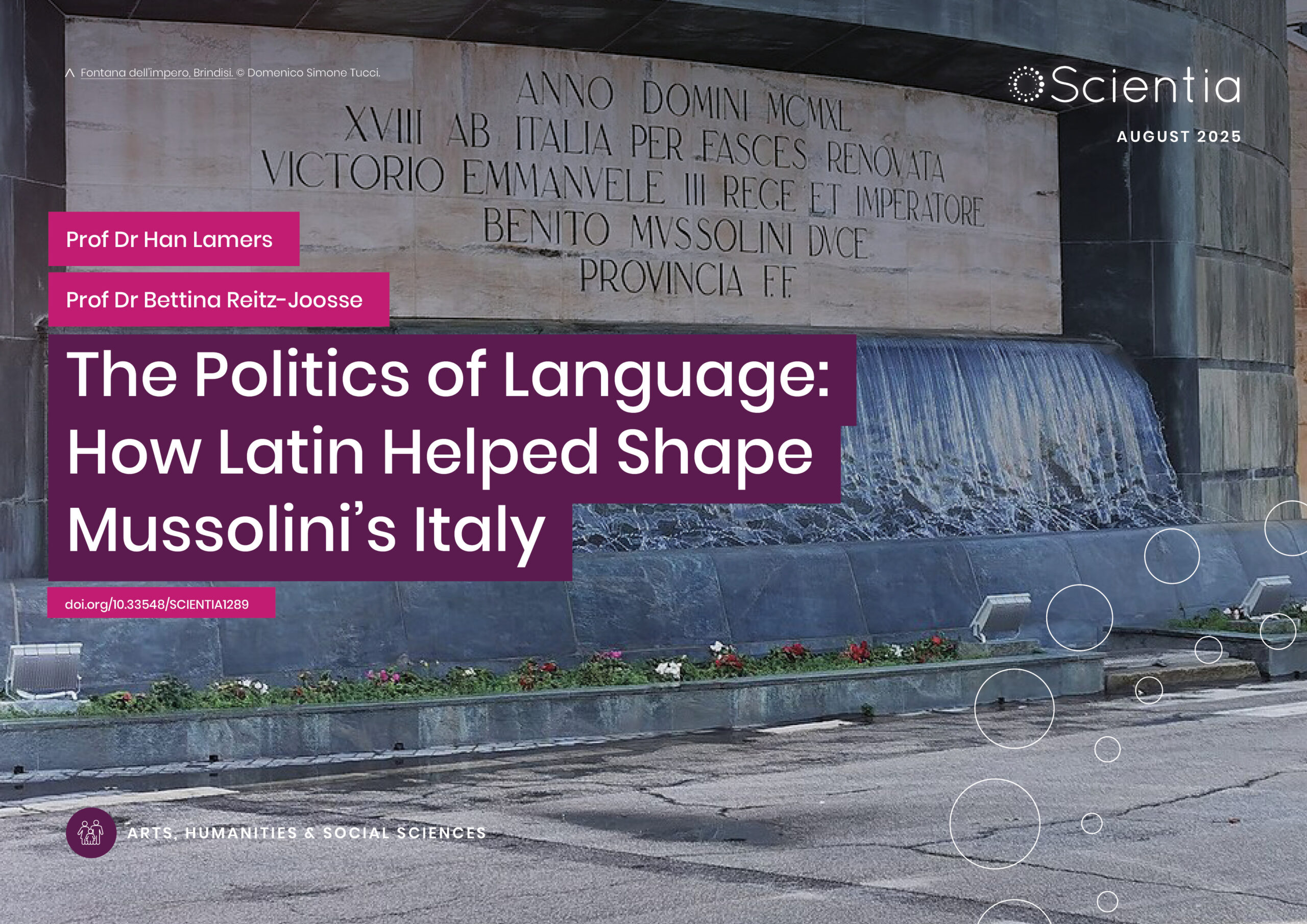
Prof Dr Han Lamers – Prof Dr Bettina Reitz-Joosse | The Politics of Language: How Latin Helped Shape Mussolini’s Italy
When wandering through Italian cities today, visitors will encounter Latin inscriptions on all manner of buildings and monuments. While many date back to ancient Rome, the Middle Ages, or the Renaissance, others were created during Benito Mussolini’s Fascist regime (1922–1943). These Latin texts weren’t merely decorative — they were deliberately crafted political tools that helped forge connections between Fascist Italy and ancient Rome, embedding the regime’s ideology into the very fabric of Italian society.
Ongoing research by Professor Han Lamers (University of Oslo) and Professor Bettina Reitz-Joosse (University of Groningen) reveals how Fascist Italy weaponized ancient Rome’s language to legitimise its power and connect Mussolini’s regime to Italy’s imperial past. Their projects involve collaboration with an international team of mostly junior researchers based in Norway, the Netherlands, Austria, and Italy.

Dr JoLee Sasakamoose – Dr Mamata Pandey | Empowering Indigenous Health: The Indigenous Wellness Research Collaborative in Saskatchewan
The Indigenous Wellness Research Collaborative is a transformative alliance dedicated to advancing health systems and service delivery for Indigenous communities across Saskatchewan. Founded a decade ago and co-led by Dr Mamata Pandey, a research scientist at the Saskatchewan Health Authority, and Dr JoLee Sasakamoose (M’Chigeeng First Nation), Canadian Institute of Health Research Chair in Indigenous Wellness and Health Equity at the University of Regina, their team’s work is rooted in a commitment to Indigenous leadership and community-defined wellness goals. Guided by the Cultural Responsiveness Framework, the Collaborative prioritises creating ethical spaces that serve as a middle ground for respect, reciprocity, and authentic partnerships. The team employs a strengths-based approach to health research, centering Indigenous methodologies that respect the interconnectedness of spiritual, mental, emotional, and physical well-being.