
DOI: doi.org/10.33548/SCIENTIA1350
MORE ARTICLES YOU MAY LIKE

Dr David Hansen – Abhishek Juneja | Coming of Age: Active Balancing in Adolescence
Adolescence, the transitional stage between childhood and adulthood, comes with challenges as well opportunities for growth and learning.

Professor Deanna Sellnow | How Strategic Communication Can Save Lives When Crisis Hits
Professor Deanna Sellnow from Clemson University argues that crisis and risk communication research must evolve beyond simply describing and deconstructing problems to actively empowering people protect themselves and their communities. In an era of increasing globalisation, she proposes that researchers adopt learner- and learning-centered approaches to ensure communication does not simply inform people about dangers, but also teaches them how to respond effectively (e.g., to reduce risks, mitigate harms, improve safety, save lives) and why.
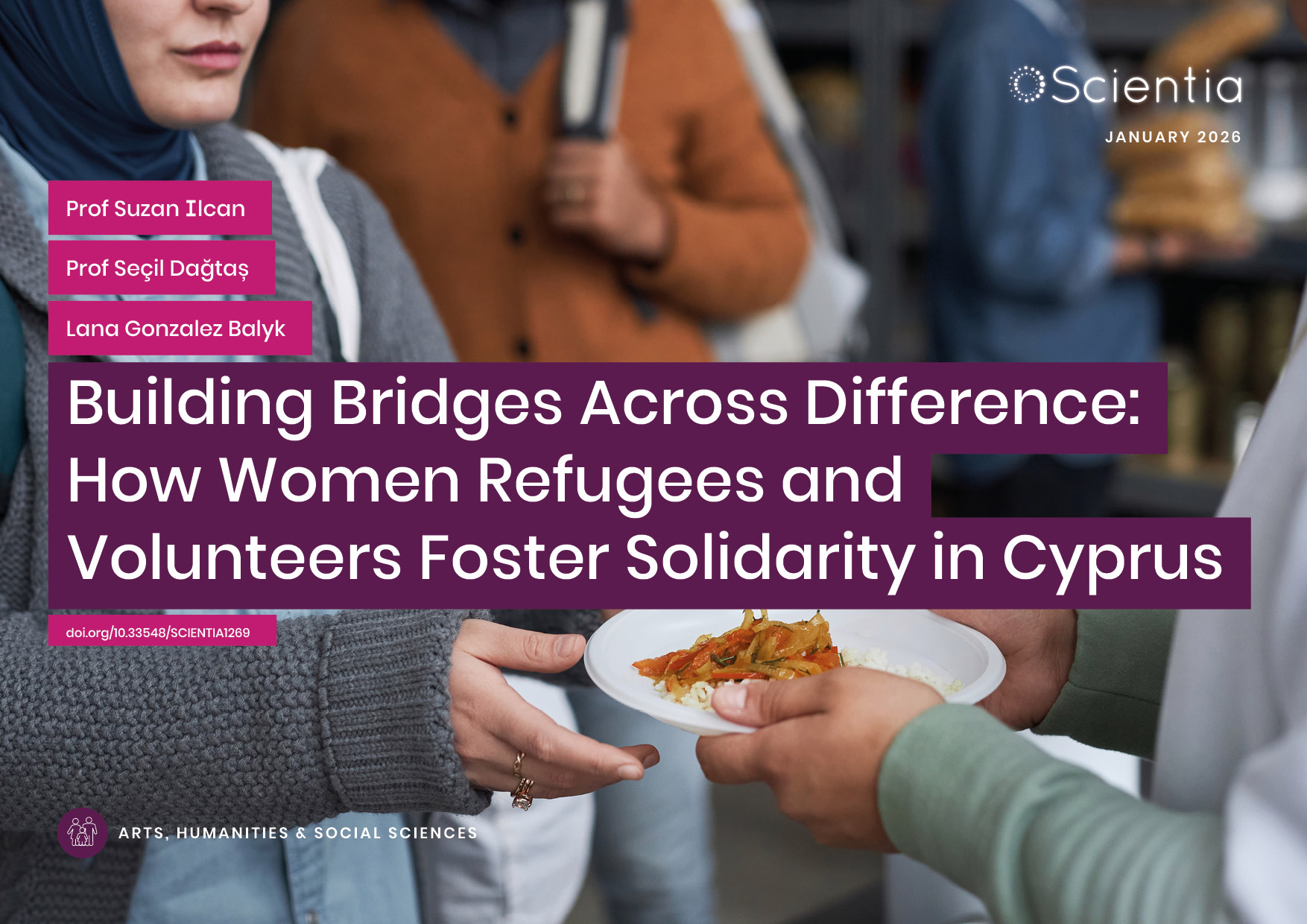
Dr Suzan Ilcan | Building Bridges Across Difference: How Women Refugees and Volunteers Foster Solidarity in Cyprus
Across Europe, refugees and asylum seekers often find themselves in precarious situations, facing limited access to housing, employment, education, and legal protection. While government responses have frequently proved inadequate, grass-roots movements have emerged to fill the gaps. These citizen-led initiatives represent more than simple charity; they embody new forms of political engagement where refugees and volunteers work together across differences to create useful change.
This issue is particularly pressing in the Republic of Cyprus (RoC), where the island’s own history of division and displacement shapes contemporary responses to newcomers. Since 2015, the RoC has experienced a dramatic increase in refugee arrivals, making it the EU member state with the highest number of asylum applications per capita in 2021. Yet despite – or perhaps because of – this pressure, women in the Cypriot city of Paphos have created remarkable spaces of collaboration and mutual support.

Police Body Worn Cameras in Rio’s Favelas: Can Technology Reduce Violence?
In 2016, a team of three researchers based at Stanford University —Beatriz Magaloni, Vanessa Melo, and Gustavo Robles— conducted a groundbreaking experiment in Rocinha, Rio de Janeiro’s largest favela (informal settlement), to test whether body-worn cameras (BWC) could reduce police violence and improve community relations.
The findings reveal that body cameras hold great promise, but they also come with serious challenges. Before the experiment started, one police unit commander ominously told the researchers: “If you give body cameras to my officers, this will stop them from doing their job.”