
Chimeric Antigen Receptor (CAR) T-cell therapy offers life-saving potential, particularly against blood cancers, but severe side effects such as cytokine release syndrome (CRS) limit its safety. These toxicities are linked to uncontrolled CAR expression levels on the T-cell surface. Led by Professor Abraham P. Lee, researchers at the University of California, Irvine, have developed an advanced microfluidic system, called the Acoustic-Electric Shear Orbiting Poration (AESOP) platform, to precisely control the dose of genetic material delivered into primary T cells. This innovation promises safer, more homogeneous, and highly effective cellular immunotherapies.
The Urgent Need for Fine Control
CAR T-cell therapy is a revolutionary advancement in cancer treatment, demonstrating unprecedented efficacy, especially for haematologic malignancies like B-cell acute lymphoblastic leukaemia (B-ALL). Despite this remarkable success, the therapy can induce potentially life-threatening toxicities, most notoriously CRS, where excessive inflammatory cytokines are released, leading to systemic immune activation. Crucially, studies have revealed that the heterogeneity and high density of CAR expression on the surface of T cells often determines both efficacy and safety, as T cells expressing a high density of CAR molecules (CARHigh T cells) are linked to excessive cytokine release and exhausted phenotypes, increasing the potential for CRS. Conversely, CARLow T cells may not be potent enough to interact effectively with tumour cells. Therefore, it’s necessary to achieve a precisely controlled method to manufacture CAR T cells with CAR expression density titrated within an optimal range.
Traditional manufacturing methods often fall short of this precision. Clinical settings frequently rely on viral vectors (such as retroviruses and lentiviruses), which offer high transduction efficiency but carry severe safety concerns, including insertional oncogenesis and heterogeneity in gene expression. Alternatively, bulk electroporation (a non-viral method that uses high voltages to temporarily destabilise the cell membrane) can deliver genes, but the high voltages often compromise cell viability and function, perturbing gene expression and cytokine production. Moreover, bulk methods lack the mixing process necessary to achieve uniform and dosage-controlled delivery across the entire cell population
Building a Better ‘Bio-CPU’
To overcome these limitations, Prof Lee and colleagues developed the Acoustic-Electric Shear Orbiting Poration (AESOP) platform. This technology acts as a ‘biological cell processing unit’ (bio-CPU) analogous to a CPU in computing, but for bioengineering.
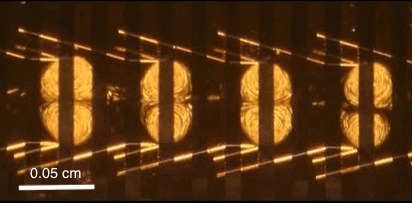
The AESOP device uses a two-step membrane disruption strategy, combining gentle mechanical shear with a low-intensity electric field, which enables the uniform delivery of genetic cargo into large populations of cells. The core innovation lies in the use of lateral cavity acoustic transducer (LCAT) technology, which traps cells inside acoustic microstreaming vortices.

The AESOP process consists of 3 stages:
- Shear-Induced Poration – Cells are trapped in whirlpool-like microstreaming vortices and subjected to oscillatory mechanical shear stress near oscillating air–liquid interfaces. This gentle, tunable, and uniform mechanical shear opens nano-sized pores on the cell membranes. The process is safe, as low to moderate shear forces (LS and MS) do not disrupt the function of primary T cells, unlike the substantial increase in pro-inflammatory cytokines (IFN-γ and TNF-α) observed after traditional electroporation.
- Electric Field Modulation – Once nanopores are present, a gentle, low-strength electric field is applied via integrated electrodes. This field uniformly enlarges the pre-existing pores without relying on the high, damaging voltages required by bulk electroporation. This two-step strategy maintains cell viability, preserving primary T-cell genotype and minimising cytokine release function.
- Chaotic Mixing and Uniform Uptake – The microstreaming vortices are crucial for achieving dosage control. They generate chaotic mixing, ensuring that the genetic material (cargo) is uniformly mixed with the T cells. As a result, each cell takes up approximately the same dosage of cargo.
Precision Pumping and Handling Large Cargo
The AESOP platform demonstrates significant advantages over conventional methods in terms of efficiency, viability, and homogeneity. Prof Lee showed that AESOP achieved a delivery efficiency of 76±9.76% and cell viability of 80.4±5.48% for primary T cells, significantly outperforming bulk electroporation, which yielded 47.5±12.74% efficiency and 44.93±8.29% viability.
Furthermore, the original AESOP design proved highly effective at handling large genetic cargos. AESOP achieved high delivery efficiency (>90%) and high cell viability (>80%) across a wide range of molecules, from small dyes (<1 kDa) up to large 2 MDa dextran molecules, in a variety of cell lines.
This capability to deliver substantial genetic material is critical for modern gene editing. For instance, AESOP successfully delivered large plasmids for eGFP (enhanced green fluorescent protein) expression (6.1 kbp) and even larger plasmids (9.3 kbp) encoding the CRISPR-Cas9 system for targeted gene knockout. The latter is challenging, as these cargo sizes often exceed the packaging capacity of popular viral vectors like adeno-associated viruses (AAVs).
A key metric demonstrating AESOP’s precision is the coefficient of variation (%CV), which quantifies the uniformity of cargo uptake across the cell population. A lower %CV indicates a more monodisperse (uniform) dosage taken by the cells. While bulk electroporation resulted in a high %CV of 97% for dextran delivery, AESOP reduced this dramatically to approximately 53.6%. Similarly, when delivering plasmid DNA, AESOP maintained a consistent and low %CV around 50%, compared to control groups with %CV >120%, showing greater control and consistency in delivery.
Titrating T-Cell Expression for Safety
The AESOP platform’s greatest functional advantage is its ability to precisely control the dosage delivered. The researchers successfully demonstrated this capability by showing a linear relationship between the input concentration of reagents (dextran and mRNA) and the resulting fluorescence intensity within the cells. For dextran, fluorescence was linearly correlated to concentration in the AESOP groups (R2=0.99), but this did not hold true for the electroporation groups (R2=0.83).
Applying this precision to CAR T-cell generation, the team used mRNA encoding anti-CD19 and a GFP-reporter. Using mRNA instead of plasmids or viral vectors allows for the transient expression of CAR, avoiding the permanent genomic integration and potential long-term risks associated with permanent expression systems (like B-cell aplasia or on-target off-tumour toxicity).
The results showed that AESOP could control the expression levels of the CAR protein by varying the input mRNA dosage (2.5, 5.0, and 7.5 μg). As the dosage of CAR mRNA increased, the CAR expression level, measured by fluorescence intensity, also increased. This finding is critical because it demonstrates the ability to titrate the CAR density on the T-cell surface, allowing researchers to potentially create CARHigh, CARMedium, and CARLow T cells. Crucially, the electroporation control group failed to show any observable shift in fluorescence intensity peaks as the mRNA dosage increased; expression levels were mostly saturated, or simply widespread and uncontrolled.

Scaling into the Future
The success of CAR T-cell therapy in a clinical setting demands platforms capable of high-throughput cell processing, often requiring millions to billions of transduced T cells.
The AESOP platform was modified to increase its throughput by modifying the system from a serial channel design to seven parallel microfluidic channels and increasing the channel height from 40 μm to 60 μm. The enhanced throughput allows the system to efficiently process the necessary volume of cells for clinical adoption. Prototypes processing up to a billion cells per chip are being developed, while still maintaining the control of dosage per cell. Commercialization efforts for these are underway by a startup called CellEcho Biotech.
By ensuring uniform, dosage-controlled, and high-throughput delivery, the AESOP acoustic-electric microfluidic system is a significant step forward in cell therapy manufacturing. The platform’s precision addresses the toxicities linked to uncontrolled CAR expression, providing a well-controlled process for generating uniform CAR T cells. Moreover, for more complex cell engineering applications the AESOP is capable of delivering multiple cargos with precise dosage. As such, this platform lays the foundation for future bio-CPUs, allowing the precision processing and ‘programming’ of cells with clinically relevant throughput. This ability to precisely titrate CAR expression levels will be vital for future scientific studies investigating how CAR density affects T-cell functionality, such as cytotoxicity and cytokine release, in physiological environments.
SHARE

DOWNLOAD E-BOOK
REFERENCE
https://doi.org/10.33548/SCIENTIA1341
MEET THE RESEARCHER
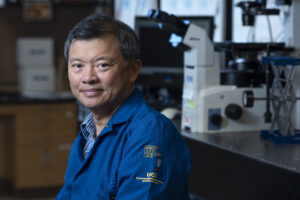
Professor Abraham Lee
Center for Advanced Design and Manufacturing of Integrated Microfluidics, Samueli School of Engineering, University of California, Irvine
Abraham (Abe) P. Lee, PhD., is the Chancellor’s Professor of Biomedical Engineering and Mechanical & Aerospace Engineering at the University of California, Irvine, holding an additional professorship in Pharmaceutical Sciences. He is also affiliated with the Chao Family Comprehensive Cancer Center, the Institute for Immunology, and the Institute of Clinical Translation Science. Dr Lee obtained his BS from National Tsing Hua University, followed by his MS and PhD from UC Berkeley. Professor Lee is a key figure in microfluidics and lab-on-a-chip technologies, pioneering microfluidic technologies based on dielectrophoresis (DEP), magnetohydrodynamics (MHD), acoustic microstreaming, and droplet emulsions.
Professor Lee’s current research focuses on the general field of microfluidics for precision medicine, with projects ranging from single cell analysis, microphysiological systems, liquid biopsy, and cell engineering to immunotherapy. He has authored over 130 journal articles and is the inventor of over 60 issued US patents. Dr Lee served as Editor-in-Chief for the Lab on a Chip journal (2017–2020), the Department Chair of Biomedical Engineering at UCI, and received the 2009 Pioneers of Miniaturization Prize. He is a respected fellow of six professional societies, including the National Academy of Inventors
CONTACT
E: aplee@uci.edu
LI: https://www.linkedin.com/in/abe-lee-176ba51/
KEY COLLABORATORS
Dr Anshu Agrawal, University of California, Irvine (UCI)
FUNDING
National Institutes of Health
National Institute of General Medical Sciences (1R01GM145987-01)
National Cancer Institute (R33CA267258)
National Science Foundation IUCRC (IIP-1841509)
Corteva Agriscience (Industry Sponsorship)
FURTHER READING
Y.-H. Chen, M. Mirza, R. Jiang, et al., Titrating Chimeric Antigen Receptors on CAR T Cells Enabled by a Microfluidic-Based Dosage-Controlled Intracellular mRNA Delivery Platform, Biomicrofluidics, 2024, 18, 064105. DOI: https://doi.org/10.1063/5.023159
M. Aghaamoo, Y.-H. Chen, X. Li, et al., High-Throughput and Dosage-Controlled Intracellular Delivery of Large Cargos by an Acoustic-Electric Micro-Vortices Platform, Advanced Science, 2022, 9, 2102021. DOI: https://doi.org/10.1002/advs.202102021


REPUBLISH OUR ARTICLES
We encourage all formats of sharing and republishing of our articles. Whether you want to host on your website, publication or blog, we welcome this. Find out more
Creative Commons Licence (CC BY 4.0)
This work is licensed under a Creative Commons Attribution 4.0 International License. 
What does this mean?
Share: You can copy and redistribute the material in any medium or format
Adapt: You can change, and build upon the material for any purpose, even commercially.
Credit: You must give appropriate credit, provide a link to the license, and indicate if changes were made.
SUBSCRIBE NOW
Follow Us
MORE ARTICLES YOU MAY LIKE

Assoc Prof. Nicholas Brown | Rethinking Prostate Care: A New Frontier in Treating Benign Prostatic Hyperplasia
For millions of men, ageing brings with it a set of frustrating and often disruptive urinary symptoms. These symptoms, caused by benign prostatic hyperplasia, or BPH, can affect sleep, confidence, and overall quality of life. Traditionally, treatment follows a familiar path. Patients begin with medications, often for years, and may eventually progress to surgery if symptoms worsen. Yet this pathway is not without its drawbacks. Medications can cause side effects, while surgery carries risks and recovery time. In recent years, a minimally invasive interventional radiology procedure called prostate artery embolisation, or PAE, has begun to challenge this traditional model. At the forefront of this shift is a collaborative research group, led by Dr. Nicholas Brown of the University of Queensland, whose series of P-EASY studies has explored whether PAE could transform how BPH is treated, particularly at earlier stages.

Jean Lycke | Addressing Unmet Medical Needs in Mucosal Disease: A Close-to-Market Innovation Approach
Recurrent Aphthous Stomatitis (RAS) is an oral condition characterized by one or several painful mucosal ulcers. RAS affects a large proportion of the population and has a point prevalence of approximately 2–3%, daily. The etiology remains unknown, and there is currently no curative treatment. Most patients experience recurring episodes over time, with each episode typically lasting up to a week. Here, we describe the development of a mucoadhesive patch which, when applied over a RAS ulcer, provides rapid pain relief. The patch is easy for patients to apply when symptoms begin and has the potential to be used as an over-the-counter product. The development of the Mucocort mucoadhesive patch is an example of a Close-to-Market innovation strategy that embraces simplicity within a complex healthcare system. By simplifying the product concept, the team has reduced the number of regulatory steps required before market approval. This MedTech/Pharma innovation model, known as the “4R” framework – Re-purposing, Re-formulation, Re-positioning, and Re-patenting – has guided the program from concept to commercialization. In addition to the biodegradable mucoadhesive patch developed for RAS ulcers, the team is extending the innovation concept to a mucoadhesive gel formulation for the prevention and treatment of chemotherapy-induced mucositis. This gel-based program is being commercialized separately through MucoShield.
The Translational Asian Agerelated Macular Degeneration Program Phase 2 (TAAP-2): Reimagining the Future of Vision Care
Age-related macular degeneration, often abbreviated as AMD, is one of the leading causes of vision loss among older adults worldwide. In Asia, where populations are ageing rapidly, its impact is particularly profound. For many, the disease quietly erodes central vision, making everyday activities such as reading, driving, and recognising faces increasingly difficult. Against this backdrop, the Translational Asian Age-related Macular Degeneration Programme, or TAAP for short, has emerged as a bold and ambitious effort to confront the disease headon. Now in its second phase, TAAP-2 represents a significant evolution in both scientific scope and clinical ambition.

Ms. Aikaterini Dritsoula | Looking Beyond Snoring: How Hidden Airway Problems Shape Children’s Sleep
For many parents, a child’s snoring may seem harmless, even endearing. Yet in some cases, it signals something more serious. Obstructive sleep apnoea is a condition in which a child’s breathing is repeatedly disrupted during sleep. These interruptions can affect growth, behaviour, and learning. Children with this condition may toss and turn at night, struggle to concentrate during the day, or show signs of hyperactivity and fatigue. Traditionally, enlarged tonsils and adenoids have been seen as the main culprits. Surgery to remove them has long been considered the standard treatment. However, research led by Consultant ENT Surgeon Ms. Aikaterini Dritsoula of The Leeds Teaching Hospitals NHS Trust invites us to look deeper. Her work suggests that the story is often more complex, especially in very young children.