
Dr Anne Hultgren | Blinding Success: How Removing Institutional Bias Improves Research Funding
New research from the Arnold and Mabel Beckman Foundation shows that blinding grant reviewers to applicants’ institutions leads to fairer funding decisions, particularly benefiting early-career scientists from less prestigious universities. The findings demonstrate how simple changes to review processes can help combat systemic biases in research funding.
Uncovering Bias in Funding Allocation
The path to scientific success often begins with securing research funding, but the process of awarding grants has long been suspected of harbouring hidden biases. When reviewers know which institution an applicant comes from, do they unconsciously favour those from prestigious universities? This question has profound implications for scientific progress and equity in research.
Studies examining bias in peer review have shown mixed results over the years. While some research suggests that blinding reviewers to applicant identities reduces bias, other studies have found little effect or even contrary results. However, most of these studies focused on gender or racial bias rather than institutional prestige.
The Arnold and Mabel Beckman Foundation, which provides vital funding for early-career scientists, decided to investigate this question systematically. In 2020, they implemented a significant change to their Beckman Young Investigator (BYI) award process – applicants would now need to submit blinded proposals that excluded their name, gender, pronouns, and institutional affiliation.
Dr Anne Hultgren, Executive Director of the Foundation, along with colleagues Nicole Patras and Dr Jenna Hicks, carefully analysed four years of data before and after this change. Their groundbreaking findings, published in eLife, reveal that institutional prestige bias does indeed influence funding decisions but also that it can be effectively counteracted through thoughtful policy changes.
How Prestigious Institutions Have Dominated Research Funding
The team examined data from 2017–2020 (before blinding) and 2021–2024 (after blinding) for the BYI programme, which supports promising young faculty in chemistry and life sciences. They looked at how applications progressed through three key stages: initial letter of intent, invitation for full application, and final award.
To measure institutional prestige, Dr Hultgren’s team used eight different ranking systems, including federal research funding data, global university rankings, and the Foundation’s own historical funding patterns. They grouped institutions into five categories, with the top 10 most prestigious universities in one group, the next 15 in another, and so on.
The results were striking. Before blinding was implemented, applicants from the top 10 institutions were 1.4–1.7 times more likely to be invited to submit full applications compared to the average. Those from the next 15 most prestigious universities were 1.2–1.4 times more likely to advance. Meanwhile, applicants from less prestigious institutions faced significantly lower odds of success.
Blinding Levels the Playing Field for Young Scientists
Dr Hultgren and her colleagues found that the new blinded review process substantially reduced this institutional bias. After blinding was implemented, the advantage for top-ranked institutions dropped significantly – they were now only 1.0–1.3 times more likely to advance compared to average, a much more equitable ratio.
Most encouragingly, researchers from less prestigious institutions saw their chances improve markedly. The relative advantage for those from institutions outside the top rankings increased from 0.60-0.83 times the average during unblinded reviews to 0.81–0.93 times with blinded reviews.
This shift meant that innovative ideas from junior faculty at less prestigious institutions, which might previously have been overlooked due to institutional bias, now had a better chance of being funded on their own merits.

Statistical Analysis Confirms the Impact of Change
To ensure their findings were robust, the team conducted detailed statistical analyses. They found that during unblinded reviews, the relationship between institutional prestige and application success was highly statistically significant across all ranking systems used.
After implementing blinding, this relationship weakened considerably. The effect size, measured by a statistical tool called Cramer’s V, decreased from an average of 0.20 (medium effect) during unblinded reviews to 0.13 (small effect) with blinded reviews.
Importantly, these changes carried through to final funding decisions. Before blinding, about 75% of awards went to applicants from the top 25 ranked institutions. After blinding, this dropped to about 45%, allowing more opportunities for excellent scientists at other institutions.
Gender Bias Not Found in Either Review System
The research team also examined whether their review process showed any gender bias, either before or after blinding. Interestingly, they found no evidence of gender bias in either period. The success rates for male and female applicants closely matched their application rates throughout all stages of review.
This finding adds nuance to the broader discussion of bias in science funding. While institutional prestige bias was clearly present and addressable through blinding, gender bias was not detected in this particular programme.
Practical Benefits Beyond Bias Reduction
Beyond the primary goal of reducing bias, the blinded review process brought unexpected practical benefits. Reviewers reported that blinded materials were easier to read and review. Panel discussions became more focused and efficient since reviewers could concentrate solely on the scientific merit of proposals.
Dr Hultgren’s team noted that compliance with blinding requirements was very high among applicants. The few proposals that failed to follow blinding rules were generally ineligible for other reasons, suggesting that implementing such policies need not create undue administrative burden.
Understanding the Limits of Bias Reduction
While the study showed clear benefits from blinding, it’s important to note that institutional differences were not completely eliminated. Dr Hultgren suggests this may reflect real advantages that well-resourced institutions provide to their faculty, such as better research infrastructure and support for grant writing.
The study period also coincided with COVID-19 disruptions, which led to fewer overall applications. However, the team found that the proportion of applications from different institutional categories remained consistent, suggesting this did not significantly impact their findings.
Looking Forward to Fairer Funding
Based on these positive results, the Arnold and Mabel Beckman Foundation has made blinded review a permanent feature of their young investigator programme and has also extended it to their postdoctoral fellowship programme. Dr Hultgren and her colleagues hope their findings will encourage other funding organisations to examine their own review processes. They suggest that blinding could be particularly valuable for early-career grant programmes, where institutional prestige bias might otherwise prevent promising young scientists from establishing independent research careers.
The team continues to monitor their application metrics and is working to increase outreach to institutions that may have fewer internal resources. They are also focusing on diversifying their reviewer pool to ensure multiple perspectives are included at all levels of the review process. This research provides compelling evidence that simple changes to review processes can help create a more equitable funding landscape in science. By reducing the influence of institutional prestige, funding organisations can better fulfil their mission of supporting the most innovative and promising research, regardless of where it originates.
SHARE

DOWNLOAD E-BOOK

REFERENCE
https://doi.org/10.33548/SCIENTIA1232
MEET THE RESEARCHER

Dr Anne Hultgren
Arnold and Mabel Beckman Foundation, Irvine, CA, USA
Dr Anne Hultgren obtained her BA in Physics and Mathematics from Franklin and Marshall College in 1999 and her PhD in Physics and Astronomy from Johns Hopkins University in 2005. She is currently the Executive Director and CEO of the Arnold and Mabel Beckman Foundation, which provides grants and awards to support basic research in chemistry and the life sciences. In this role, Dr Hultgren oversees the Foundation’s annual support to Beckman Institutes and Centers as well as local and national grant programmes, including the Beckman Young Investigator Awards, Arnold O. Beckman Postdoctoral Fellowships, Beckman Scholars Program, and Instrumentation Grants. Prior to joining the Foundation, she served as acting Division Director of the Chemical and Biological Defense Division at the Department of Homeland Security’s Homeland Security Advanced Research Projects Agency (HSARPA). There, she was responsible for overseeing research programmes focused on countering chemical and biological threats.
CONTACT
E: pr@beckman-foundation.org
W: https://www.beckman-foundation.org/
X: https://twitter.com/BeckmanFnd
IG: https://www.instagram.com/beckmanfoundation
LI: https://www.linkedin.com/company/arnold-and-mabel-beckman-foundation
KEY COLLABORATORS
Nicole Patras, Arnold and Mabel Beckman Foundation
Dr Jenna Hicks, Health Research Alliance
FURTHER READING
AE Hultgren, NMF Patras, J Hicks, Meta-Research: Blinding reduces institutional prestige bias during initial review of applications for a young investigator award, eLife, 2024, 13, DOI: https://doi.org/10.7554/eLife.92339

REPUBLISH OUR ARTICLES
We encourage all formats of sharing and republishing of our articles. Whether you want to host on your website, publication or blog, we welcome this. Find out more
Creative Commons Licence (CC BY 4.0)
This work is licensed under a Creative Commons Attribution 4.0 International License. 
What does this mean?
Share: You can copy and redistribute the material in any medium or format
Adapt: You can change, and build upon the material for any purpose, even commercially.
Credit: You must give appropriate credit, provide a link to the license, and indicate if changes were made.
SUBSCRIBE NOW
Follow Us
MORE ARTICLES YOU MAY LIKE
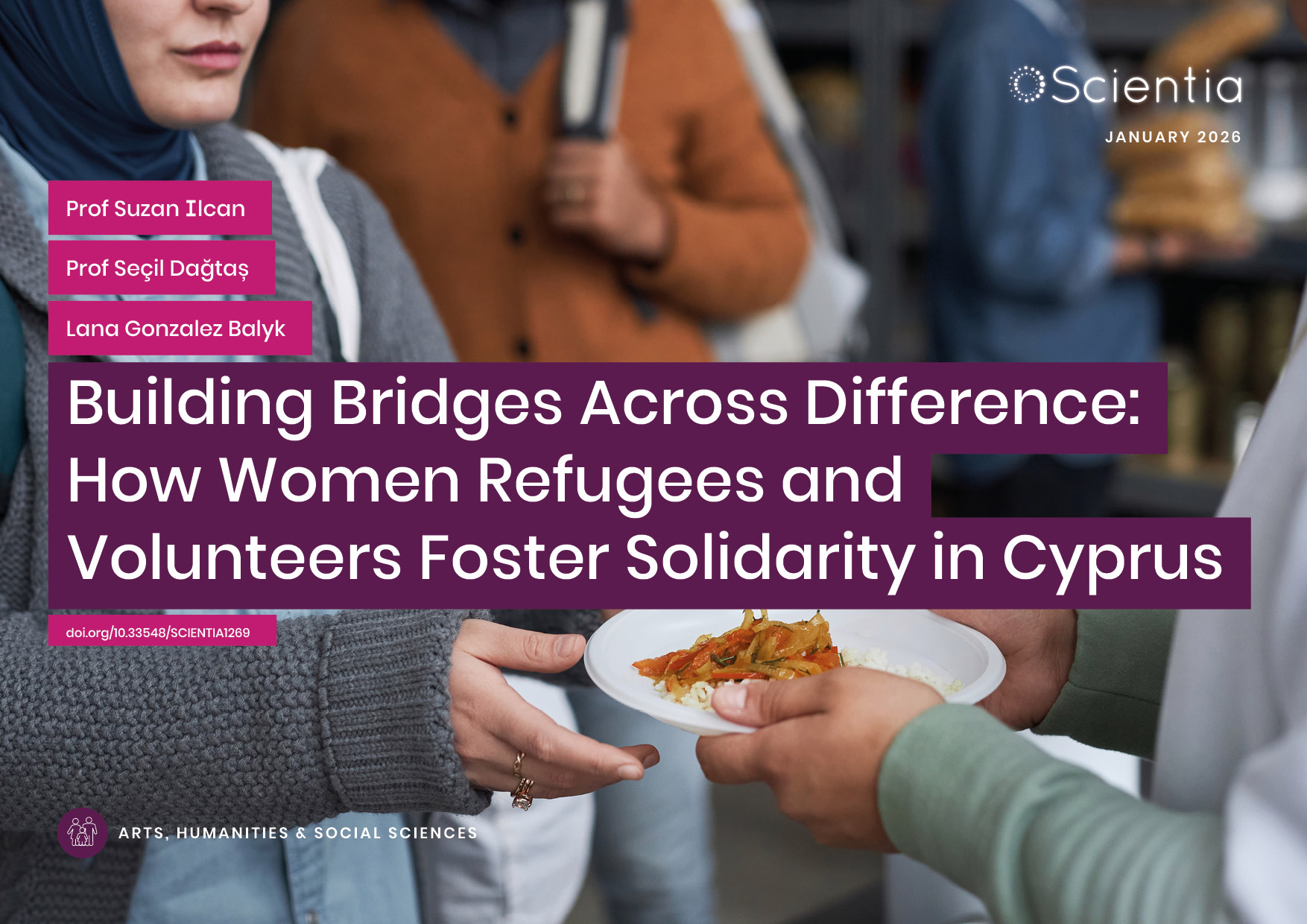
Dr Suzan Ilcan | Building Bridges Across Difference: How Women Refugees and Volunteers Foster Solidarity in Cyprus
Across Europe, refugees and asylum seekers often find themselves in precarious situations, facing limited access to housing, employment, education, and legal protection. While government responses have frequently proved inadequate, grass-roots movements have emerged to fill the gaps. These citizen-led initiatives represent more than simple charity; they embody new forms of political engagement where refugees and volunteers work together across differences to create useful change.
This issue is particularly pressing in the Republic of Cyprus (RoC), where the island’s own history of division and displacement shapes contemporary responses to newcomers. Since 2015, the RoC has experienced a dramatic increase in refugee arrivals, making it the EU member state with the highest number of asylum applications per capita in 2021. Yet despite – or perhaps because of – this pressure, women in the Cypriot city of Paphos have created remarkable spaces of collaboration and mutual support.

Prof Han Lamers | How Early Modern Scholars Used Ancient Greek to Shape Their National Identities
In early modern Europe, ancient Greek was far more than a scholarly pursuit. Intellectuals from many regions discovered that demonstrating resemblance of their native languages to Greek could elevate their cultural status, support claims of superiority over rival languages, and even advance religious and political causes. Sometimes called ‘Hellenising’, this phenomenon saw scholars from Italy to France, Germany, and the Netherlands, deliberately revealing —and often inventing— Greek features in their mother tongues.
Understanding how this worked requires examining specific cases where scholars used Greek to reshape their languages and advance their own agendas.

Police Body Worn Cameras in Rio’s Favelas: Can Technology Reduce Violence?
In 2016, a team of three researchers based at Stanford University —Beatriz Magaloni, Vanessa Melo, and Gustavo Robles— conducted a groundbreaking experiment in Rocinha, Rio de Janeiro’s largest favela (informal settlement), to test whether body-worn cameras (BWC) could reduce police violence and improve community relations.
The findings reveal that body cameras hold great promise, but they also come with serious challenges. Before the experiment started, one police unit commander ominously told the researchers: “If you give body cameras to my officers, this will stop them from doing their job.”
Dr Carolina Montero Orphanopoulos | Fundamental Theological Ethics ‘In Exit’: A New Moral Theology
Dr Carolina Montero Orphanopoulos contends that contemporary Catholic moral theology has become mired in combative debates around personal health choices and sexuality, losing sight of broader ethical challenges. She proposes a radical renewal through three key categories for progress: vulnerability, corporality, and recognition. Drawing on Pope Francis’s vision of ‘theology in exit’ (the Church actively engaging with the world), she argues for a public-facing moral framework that addresses 21st-century crises such as climate change, artificial intelligence, and political fragmentation, while remaining grounded in traditional Catholic values.