
Dr Birgitta Dresp-Langley | An Exciting New Perspective on the How and Why of Consciousness
Consciousness is a vast and complex topic. Dr Birgitta Dresp-Langley, Research Director at the Centre National de la Recherche Scientifique (CNRS) in France, takes a revolutionary and exciting new perspective in her reasoning on how consciousness came to be and how we can harness its power for a better world.
Defining Consciousness
A specific and consensual definition of consciousness continues to elude scientists. Very broadly defined, consciousness can be considered to be a mental state that one is aware of being in. Field theories have been influential in the study of consciousness and depend upon objectively measurable interactions in space and time. In other words, they seek to examine patterns of interaction between an individual and the total field – their environment. While these theories can account for specific aspects of brain-behaviour function (such as memories, decisions and actions), they do not encompass the entirety or the complexity of conscious experience – and certainly not why or how it came to be in the first place.
The so-called ‘hard problem of consciousness’ refers to the difficulty in finding brain measures of the complex phenomenon we want to study, such as the ‘self’ and experiences of ‘I am’, ‘I feel’ and ‘I will be’. We can study cognitive processes such as conscious perception, memory, decision-making and behaviour, and determine where in the brain these take place, but consciousness itself is a different matter. Phenomenal experiences, such as specific instances of perception (think of tasting a strong coffee and holding the hot mug in your hands on a cold day) occur across multiple regions and networks in the brain. But where does consciousness itself reside? And how did it come to be?

The Construction of Consciousness in Time
Dr Birgitta Dresp-Langley, Research Director at the Centre National de la Recherche Scientifique (CNRS) in France, is working to overcome the limitations of existing theories and address many unanswered questions about the how and why of consciousness.
In 2009, Dr Dresp-Langley and nuclear physicist, Dr Jean Durup, borrowed from the field of physics to propose that we have a biophysical brain code that works independently of cognitive processes such as perception and decision-making. They suggested that the brain code provides a generic mechanism that serves to trigger, maintain and terminate individual conscious states.
The researchers were interested in developing a computational account that held true to the idea that consciousness reflects a specific state of being in time but does not depend upon physical (spatial) location. The absence of an observable spatial dimensionality to consciousness is critical to Dr Dresp-Langley’s approach and she points to how readily we can recollect the past and mentally simulate future events that haven’t (and might never) happen. For example, most of us could cast our minds back to a particularly happy birthday or perhaps a difficult relationship breakdown with ease. Likewise, we can probably readily imagine what it might be like to win the lottery (even though the chances of this happening in real life are extremely slim).
She argues that this active construction of consciousness in time is fundamental to much of our conscious human life. Indeed, early in childhood, we learn much about the temporal order of the physical world long before we become aware of higher-order concepts such as the self. For centuries, philosophers have proposed that consciousness represents our recognition that we exist in, and are part of, moments in time. In an extension of this, it has further been argued that human consciousness may have progressively evolved from the primitive ability to be aware of, to remember, and to predict temporal order and change in our environment.
Dr Dresp-Langley takes the perspective that consciousness, while associated with these cognitive processes, transcends them, noting, ‘By changing and developing with experience, in interaction with other beings, society, and the physical world, it [consciousness] creates potential for mobilizing new resources beyond currently existing or known physical boundaries.
Conscious Energy
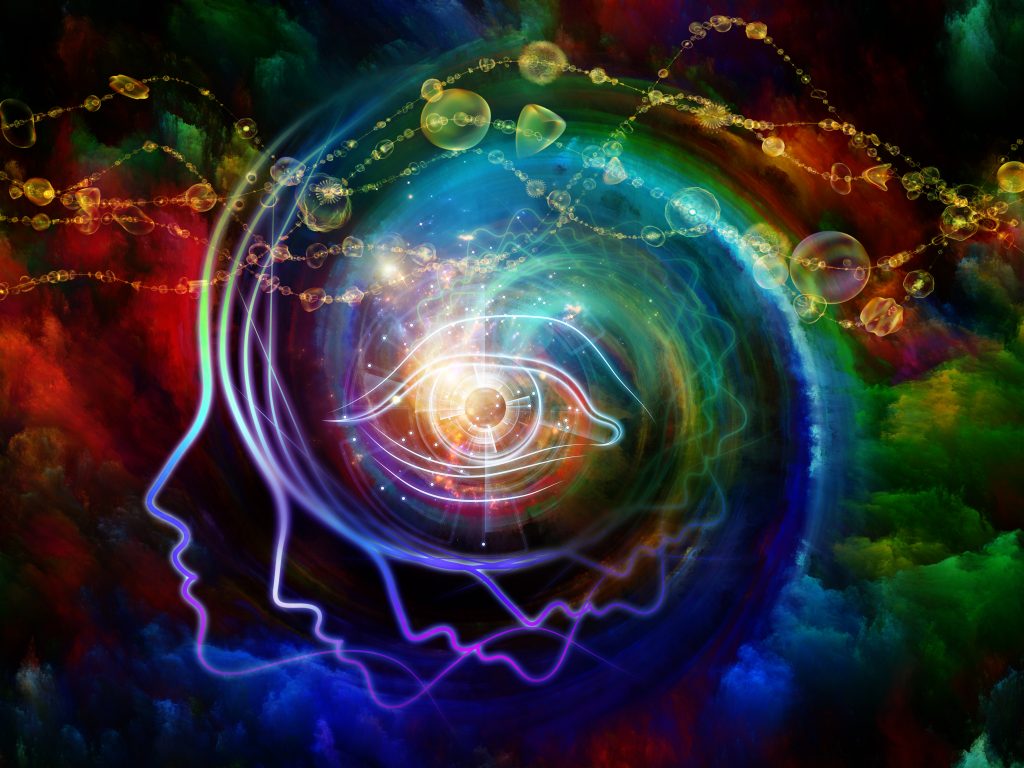
Consciousness drives human creativity and the technological and cultural development of human societies as we know them. As such, Dr Dresp-Langley argues, consciousness may be seen as a form of energy – one that can lead to observable changes in ourselves, others and our physical environments. This means that consciousness also has the power to change and/or determine the future mental states of ourselves and others, and also change and/or determine future physical environments.
The origin of conscious energy is within the brain and the potential is boundless. Conscious energy underpins human creativity, the driving force of the advancement of society most broadly as we have noted. Yet there is much that still yet to be explored and our understanding of the individual and collective power of consciousness is still very limited. This is a particular interest for Dr Dresp-Langley.
Expanding Levels of Consciousness for a Better Life
Given the role of consciousness as a vital energy source, Dr Dresp-Langley points to the relevance of techniques that expand consciousness, such as meditation and mindfulness practice. She proposes that these approaches could allow us to adjust our individual expectations, and find greater purpose and fulfilment in our lives, despite any adversity that we may encounter. In this way, the energy of consciousness could be harnessed to become a fundamental driving force in achieving a better life across the lifespan.
Dr Dresp-Langley’s profound work brings us to the notion that our conscious minds are not confined to what we can objectively measure, and thus, this approach is limited. Instead, she argues that we should focus our efforts on furthering our understanding of how we can expand our consciousness to improve health and well-being on individual and societal levels. Perhaps her most radical yet intriguing suggestion is that consciousness may have evolved to enable us to plan for both our survival and our extinction. We look forward to her further work on this exciting perspective.
SHARE

DOWNLOAD E-BOOK
REFERENCE
https://doi.org/10.33548/SCIENTIA877
MEET THE RESEARCHER
Dr Birgitta Dresp-Langley
Centre National de la Recherche Scientifique (CNRS)
Paris
France
Dr Birgitta Dresp-Langley is a Research Director at the Centre National de la Recherche Scientifique (CNRS) in France. She obtained her PhD in Cognitive Psychology at Paris Descartes University and joined the CNRS in 1993. Dr Dresp-Langley has authored more than 100 articles in peer-reviewed multidisciplinary scientific journals, several book chapters, and is an independent scientific expert to the European Commission. She also sits on the Editorial Board of several international scientific journals published by Elsevier, Frontiers and MDPI. She has extensive expertise in the fields of brain-behaviour function, perception and cognition, human intelligence, and artificial intelligence.
CONTACT
E: birgitta.dresp@cnrs.fr
W: https://cv.hal.science/birgitta-dresp
FUNDING
Centre National de la Recherche Scientifique
FURTHER READING
B Dresp-Langley, Consciousness Beyond Neural Fields: Expanding the Possibilities of What Has Not Yet Happened, Frontiers in Psychology, 2022, 12, 762349. DOI: https://doi.org/10.3389/fpsyg.2021.762349
B Dresp-Langley, A Hutt, Digital Addiction and Sleep, International Journal of Environmental Research and Public Health, 19(11), 6910. DOI: https://doi.org/10.3390/ijerph19116910
B Dresp-Langley, Children’s Health in the Digital Age, International Journal of Environmental Research and Public Health, 2020, 6;17(9), 3240. DOI: https://doi.org/10.3390/ijerph17093240

REPUBLISH OUR ARTICLES
We encourage all formats of sharing and republishing of our articles. Whether you want to host on your website, publication or blog, we welcome this. Find out more
Creative Commons Licence (CC BY 4.0)
This work is licensed under a Creative Commons Attribution 4.0 International License. 
What does this mean?
Share: You can copy and redistribute the material in any medium or format
Adapt: You can change, and build upon the material for any purpose, even commercially.
Credit: You must give appropriate credit, provide a link to the license, and indicate if changes were made.
SUBSCRIBE NOW
Follow Us
MORE ARTICLES YOU MAY LIKE
Professor Abraham P. Lee | Delivering Cancer Immunotherapy with Acoustic-Electric Precision, AESOP’s Fact not Fable
Chimeric Antigen Receptor (CAR) T-cell therapy offers life-saving potential, particularly against blood cancers, but severe side effects such as cytokine release syndrome (CRS) limit its safety. These toxicities are linked to uncontrolled CAR expression levels on the T-cell surface. Led by Professor Abraham P. Lee, researchers at the University of California, Irvine, have developed an advanced microfluidic system, called the Acoustic-Electric Shear Orbiting Poration (AESOP) platform, to precisely control the dose of genetic material delivered into primary T cells. This innovation promises safer, more homogeneous, and highly effective cellular immunotherapies.

Dr Ray Stewart | Barriers to Dental Care for People with Special Needs: A Crisis of Neglect and Inaction
For people with special healthcare needs, something as basic as visiting a dentist can be nearly impossible. A ground-breaking paper by researchers at the University of California, San Francisco (UCSF) exposes the scale of this crisis. By outlining potential paths forward, Dr Ray Stewart and Dr Ben Meisel offer hope for significant improvements in access to essential dental care.
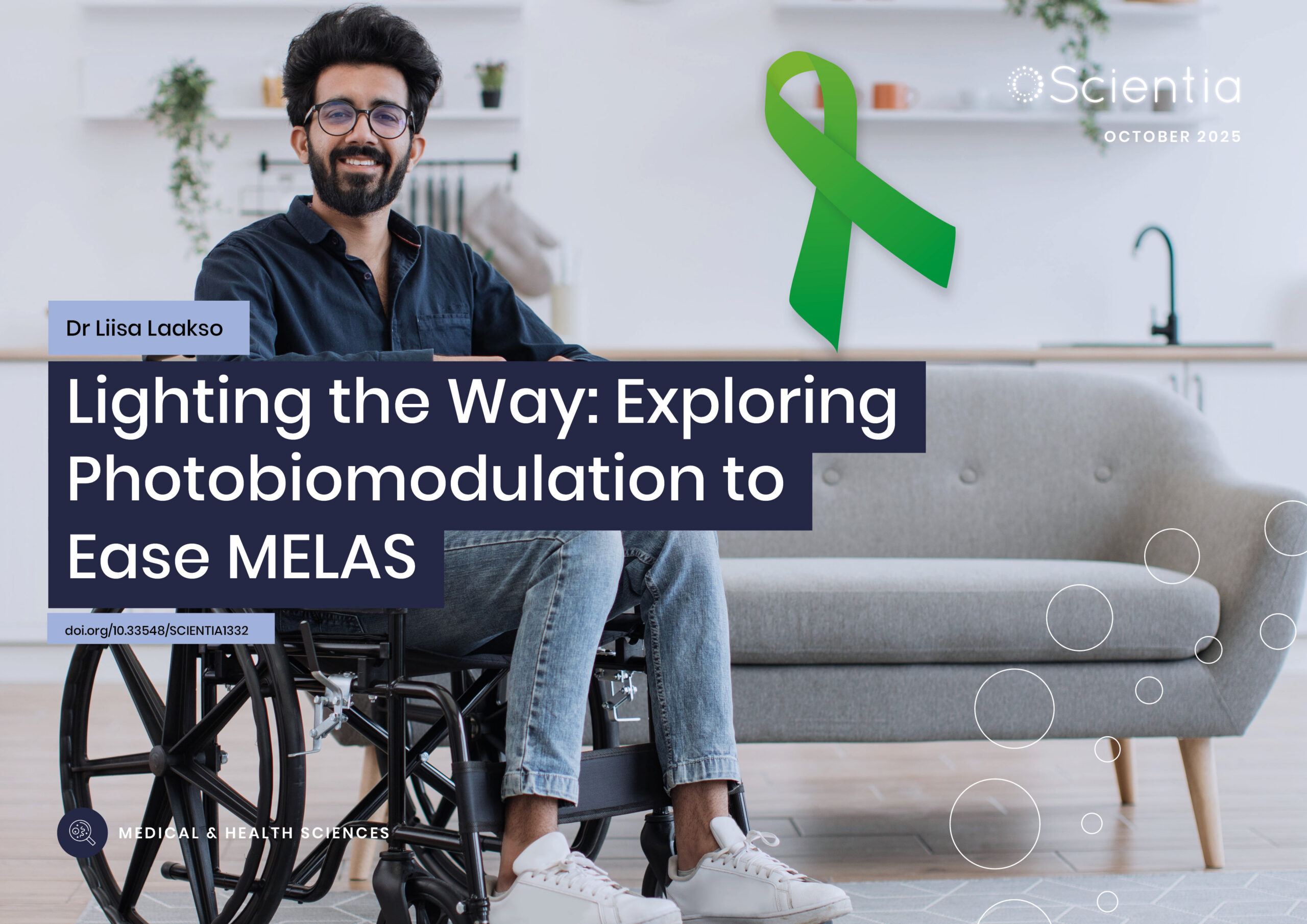
Dr Liisa Laakso | Lighting the Way: Exploring Photobiomodulation to Ease MELAS
MELAS is a rare and serious genetic condition that affects how the body’s cells produce energy, leading to extreme fatigue, muscle weakness, and a range of other symptoms. With no cure currently available, treatment focuses only on managing complications.
A team of researchers led by Dr Liisa Laakso at the Mater Research Institute-University of Queensland, Australia, is exploring an innovative, non-drug therapy called photobiomodulation, which uses light to stimulate mitochondria to work more efficiently. This pioneering study will provide intial evidence on whether PBM can safely reduce fatigue and improve quality of life for people living with MELAS, paving the way for future clinical trials.

Professor John Paul Pezacki, PhD, FRSC (UK) | Engineering Proteins for the Prevention of Disease Progression
The way in which viruses invade and replicate within their hosts involves a multilayered system of protein-based interactions, and understanding the mechanisms at play is crucial when developing potential treatments. Utilising new techniques such as genetic code expansion, Professor John Paul Pezacki and his team of researchers at the University of Ottawa in Canada have designed a novel, highly specific artificial protein complex which can halt the progression of viral infections in human cells. They have identified and described a novel approach to wider preventative and restorative therapeutics in human disease.