
Dr John Slough | Fuelling the Next Generation of Rockets with Nuclear Fusion
Most rockets combine liquid hydrogen and oxygen to throw out extremely hot, expanding gas as a propellant; however, there are limits to the efficiency of this system. Dr John Slough and his colleagues at MSNW and the University of Washington have been developing new ways to propel spacecraft, with inspiration from the process that powers the Sun: nuclear fusion. Using an innovative design, his fusion-driven rocket converts the energy output of a fusion reaction directly into the propellant, opening new opportunities for space travel and exploration.
Space Travel
In 1901, the Wright brothers tested their experimental airplane at Kitty Hawk. It was a failure, and on the train home, Wilbur Wright dejectedly decried the idea of heavier-than-air flight, declaring that humans would not fly in a thousand years. However, the brothers persevered, and two years later they made history with the first airplane flight at the same site, though the plane travelled less than the wingspan of a Boeing 747. Just 66 years later, the Saturn V rocket took Neil Armstrong, Buzz Aldrin, and Michael Collins to the moon.
If we look back at these technological breakthroughs now, 50 years on from Apollo 11, we might wonder where the momentum went. Why does it feel like there’s been so little progress since the moon landing? This is likely because space travel is still extortionately expensive, as there is no easy way to heave mass from the surface of the Earth into space.
Last Christmas, the James Webb Space Telescope was launched atop the Ariane 5 rocket, which uses the same main system as the Saturn V and many rockets before it: combining liquid oxygen and hydrogen to produce a hot, rapidly expanding gas that is hurled towards the ground by the pressure, lifting the rocket from Earth’s surface.
The problem is, fuel is needed to launch a spacecraft, but that fuel is heavy too. Also, it can’t be burned all at once, so the spacecraft must carry enough fuel for the whole launch and for the rest of the journey. For instance, the Ariane 5 rocket used over 400 tonnes of fuel to get the 6.5 tonne James Webb Space Telescope into orbit.
If space travel is to follow the trend of air flight, we need to dramatically improve how spacecraft are propelled. Dr Slough believes that the key is to stop using chemical energy, and to harness nuclear energy, and specifically fusion nuclear energy, instead.
Nuclear Fusion
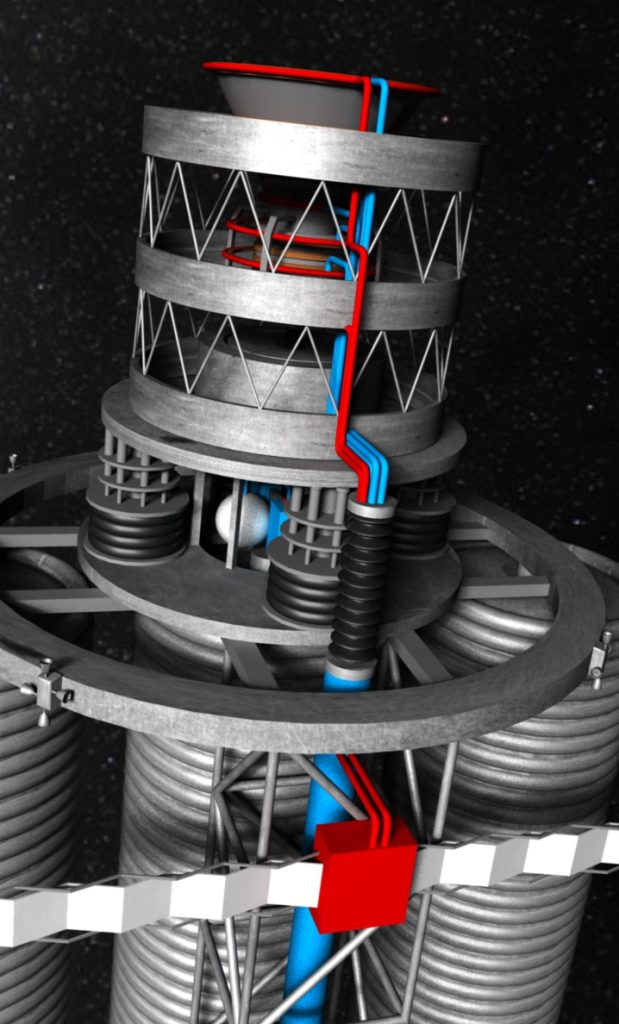
Dr Slough and his collaborators have been developing a novel rocket design, using the same process that powers the sun: nuclear fusion.
Under intense heat and pressure, two atoms overcome the repulsive force between them and fuse into a single, heavier atom. Typically, this involves the fusion of hydrogen, the lightest and most abundant element, into helium. However, the end product is a little lighter than you might expect – it weighs less than the sum of the two atoms that formed it. Einstein’s famous equation, e = mc2, tells us that this little bit of mass is equivalent to a lot of energy, and it’s this energy that powers the sun.
While fusion produces a lot of energy, it is not easy to achieve. The pressure in the core of the sun is 180 billion times greater than Earth’s atmosphere, and the temperature is 15 million degrees Celsius. How can we replicate this on Earth?
While fusion energy has been produced on Earth in the form of an immense nuclear explosion (the H-Bomb), controlled nuclear fusion has been a frustrating area of research for over 60 years. Fusion seemed to offer unlimited clean energy, but progress has been slower than many hoped. As the old joke goes, fusion power is 30 years away, and always will be. There are many approaches to fusion, but they all rely on confinement. The fuel must be kept in an environment with extreme temperature and pressure for long enough for the reaction to occur. There are two main ways to confine the fuel, and both are crucial to Dr Slough’s rocket design.
The first is relatively straightforward: compress the fuel. Compressing a pellet of fuel causes the outer surface of the pellet to explode outwards, generating shockwaves that travel inward and initiate the fusion reaction. This is called inertial containment, and it simultaneously confines the fuel, while also raising the temperature and pressure. However, this compression must be symmetrical, and it must deliver a lot of energy in an extremely precise way in just a few nanoseconds.
The second, more common approach, is magnetic confinement. Heating a solid will melt it into liquid – heat that liquid further and you get a gas. If you continue to heat that gas, it will undergo another phase transition, where the electrons are ripped from their constituent atoms, which results in a plasma. Crucially, plasmas are charged, since the negatively-charged electrons are no longer bound to the positively charged nucleus. This means you can manipulate plasma using magnets.
For example, one of the world’s largest fusion experiments, called the ITER Tokamak, uses electromagnets that have been cooled to almost absolute zero (or −273 degrees Celsius) to confine the plasma. The plasma itself is heated to over 150 million degrees – ten times hotter than the core of the sun.
To generate electricity, the heat produced by a nuclear fusion reaction would be used to heat water, which would evaporate into steam that can turn a turbine. So far, though, no research group has created a reactor that produces more energy than is required to confine, trigger, and maintain the reaction.
However, a fusion-driven rocket does not need to be efficient in the same way as a power plant does. The utility of a rocket is in its ability to generate a lot of thrust per kilo, whereas the utility of a power plant is to produce surplus energy. This is where the energy density of nuclear fuel compared to chemical fuel is key.
Pulsed Magneto-Inertial Fusion
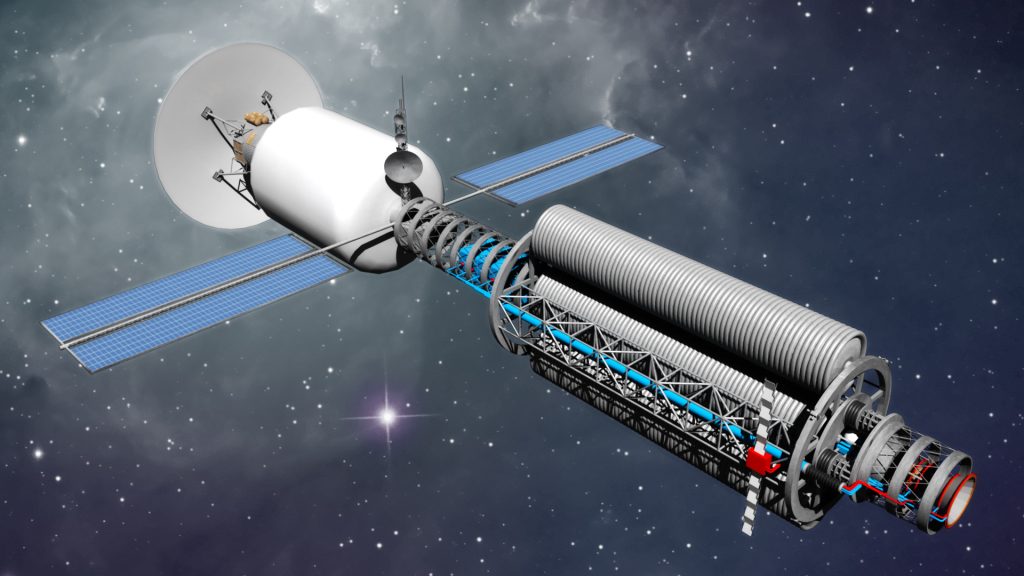
The rocket that Dr Slough has designed will be powered by a ‘pulsed magneto-inertial fusion reaction’. Here, ‘pulsed’ means that the reaction occurs in distinct pulses, rather than continuously, while ‘magneto-inertial’ means that this rocket will use a combination of magnetic and inertial confinement, as described above. This design accelerates an array of lithium metal bands radially inwards, which compresses the fuel.
The key to the efficiency of this fusion-powered rocket is that there is no intermediate step, such as the heating of water to turn a turbine in a power plant. The lithium bands that compress the fuel also become the propellant – the material that is thrown backwards to propel the craft forward.
As the fuel is compressed, the lithium forms a five-centimetre shell around the fuel, acting as a fusion blanket that absorbs most of the fusion and plasma energy. This superheats the lithium shell and ionises it into a plasma that rapidly expands. Since the plasma is charged, magnetic fields can direct the ionised lithium through a nozzle, generating thrust.
This directly converts the fusion energy into a fast-moving propellant, transferring the energy far more efficiently than in a conventional fusion reactor. This also protects the thruster as well as the spacecraft from the intense energy generated by the fusion reaction, as the magnetic field isolates the chamber walls from the energetic plasma ions.
Propelling a Crewed Mission to Mars
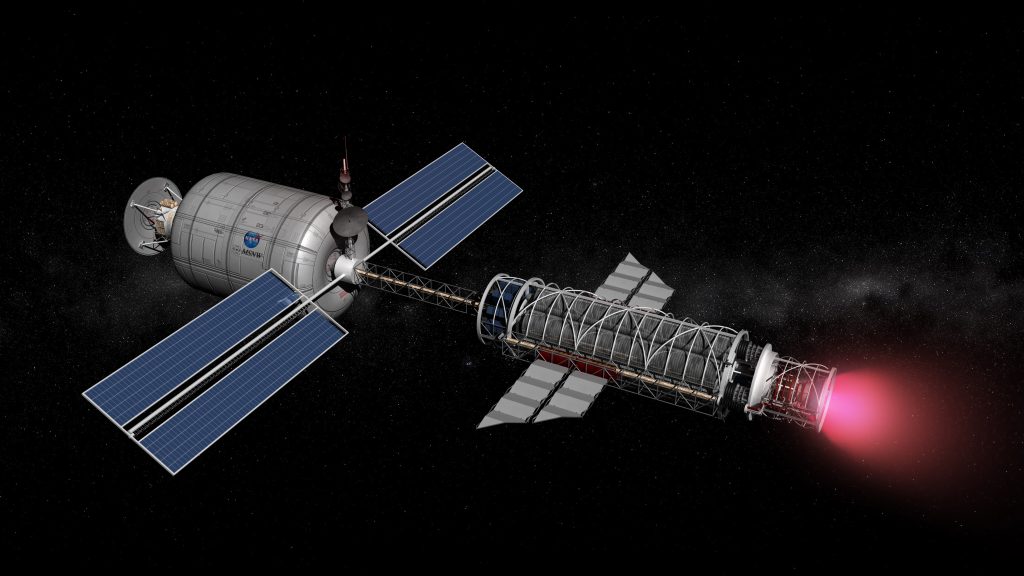
Dr Slough and his collaborators argue that this innovative fusion-driven rocket could fuel the next generation of spacecraft, including a crewed mission to Mars. The team has carefully modelled and analysed several potential mission plans, using the fusion rocket in a realistic mission to the red planet.
They propose a 210-day round trip, with 30 days on the surface of Mars. In contrast, the last mission to Mars took 203 days for a one-way trip. A crewed mission would have a mass of roughly 150 tonnes, while the largest previous spacecraft to land on Mars weighed less than 1 tonne.
Dr Slough and his team have also tested different variations of their mission design, including larger payloads and faster trips. For instance, one of their variations involves a feasible 93-day round trip with just three days on the surface. As well as reducing the supplies – and thus fuel – required, a shorter mission would also minimise astronauts’ exposure to zero gravity and radiation, both of which pose real dangers to the human body in space.
While the technical challenges of fusion-driven rockets are immense – it is, after all, rocket science – Dr Slough and his colleagues continue to refine and improve their designs, and many experiments across the world are showing that pulsed fusion represents a real possibility for the future of rocketry and space travel. In the next few decades, we may see rocketry take off as fusion fuels a renaissance in space travel and crewed exploration of the solar system.
SHARE

DOWNLOAD E-BOOK
REFERENCE
https://doi.org/10.33548/SCIENTIA858
MEET THE RESEARCHER
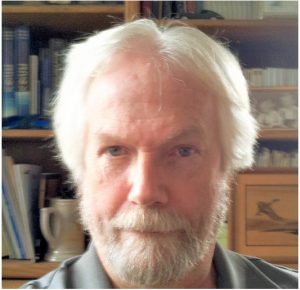
Dr John Slough
MSNW LLC
Bellevue, WA
USA
Dr John Slough achieved his PhD in Astrophysics at Columbia University. He has since worked for over four decades as an experimental physicist, in both industry and academia. During this time, Dr Slough has published almost 200 hundred papers and has been granted 10 patents. In 1991, he founded the company MSNW: which went on to establish a long history of research and development in cutting-edge concepts in nuclear fusion, advanced space propulsion, and numerous other plasma physics technologies. Highlights from Dr Slough’s research include several large fusion projects funded by the US Department of Energy, and a variety of novel concepts in spacecraft thruster designs. To develop a concept called ‘The Fusion Engine’ into a commercial fusion reactor, he also founded the company Helion Energy, which received an 8 million dollar grant from ARPA-E, and has now obtained venture capital funding exceeding 500 million dollars.
CONTACT
E: sloughj@UW.edu
E: sloughj@msnwllc.com
FUNDING
NASA Institute for Advanced Concepts
US Department of Energy.
FURTHER READING
J Slough, A Pancotti, D Kirtley, G Votrobek, Electromagnetically driven fusion propulsion, 2013, IEPC-2013.372.
REPUBLISH OUR ARTICLES
We encourage all formats of sharing and republishing of our articles. Whether you want to host on your website, publication or blog, we welcome this. Find out more
Creative Commons Licence (CC BY 4.0)
This work is licensed under a Creative Commons Attribution 4.0 International License. 
What does this mean?
Share: You can copy and redistribute the material in any medium or format
Adapt: You can change, and build upon the material for any purpose, even commercially.
Credit: You must give appropriate credit, provide a link to the license, and indicate if changes were made.
SUBSCRIBE NOW
Follow Us
MORE ARTICLES YOU MAY LIKE
Sara F Martin | The New Paradigm: Two Fundamental 22-year Solar Cycles Always Present on the Sun
For millennia, humans have looked up towards the life-giving Sun and sought to understand its nature. One of its earliest features noticeable before the age of technology was the presence of small dark patches scattered across its surface – sunspots. These blemishes appeared to wax and wane on a regular 11-year cycle, which was thought for over a century to be a fundamental time period governing the Sun’s magnetic activity. But new discoveries suggest a radically different understanding where sunspots are merely peak phases of two, more fundamental 22- year magnetic cycles present simultaneously in different bands of latitude.

Professor Tian Yu Cao | Twistor Theory: A New Framework for Quantum Gravity
At Boston University, Professor Tian Yu Cao is rethinking the foundations of modern physics. His work builds on twistor theory which demonstrates that spacetime is secondarily derived from twistor constructions, but goes further to highlight the most important implication of the Penrose transform in that the primary physical agents can only be mathematically described by elements of cohomology with the defining feature having roots in spin. This view of primary agents combines with Cao’s other major claim that quantum behaviour itself may arise from the physical property of spin leads to a new consistent framework of quantum gravity in which long-standing puzzles in black holes (evaporations) and cosmology (transitions between cycles of cosmos) can be adequately addressed, with the crucial help from the on-going development of operator product expansion formular defined on twistor space.
Professor Mikhail V. Medvedev | Plasma Waves in Extreme Magnetic Fields: Exploring the Quantum Regime
In environments where magnetic fields exceed even the limits of classical physics, such as magnetars and next-generation laser experiments, plasma behaviour is fundamentally altered by quantum effects. Professor Mikhail V. Medvedev and colleagues have developed a framework to understand how these extreme conditions reshape plasma waves, revealing that while familiar wave structures persist, their properties are significantly modified. These insights provide a foundation for interpreting astrophysical observations and advancing high-energy plasma experiments.

Alex Spezowka | Responsible Research Writing in the Age of AI: From Detection to Transparency
Artificial intelligence is often discussed as a future challenge for research, yet it is already shaping how many papers are written. Drawing on emerging evidence and recent analysis, work led by Alex Spezowka highlights a key shift in thinking: rather than trying to detect AI use, the focus is moving towards how it can be used responsibly. This has important implications for how research is produced, evaluated, and trusted.