
Dr Sebastian Rabien | Making Membrane Mirrors for Future Space Telescopes
Article written by Imogen Forbes, MSci
Mirrors play a key role in space telescopes, but to keep increasing the scale of this technology, mirrors need to be light and compact, so they can be transported in spacecraft, but also able to be adaptively corrected and controlled to ensure their accuracy. Dr Rabien and his colleagues from the Max Planck Institute for Extraterrestrial Physics, in Germany, have developed a technique to make extremely thin and lightweight mirrors, which can then be controlled with adaptive optics, making them a potential solution for larger space telescopes.
The Role of Mirrors in Space Telescopes
Space telescopes, such as the Hubble and James Webb telescopes, allow us to learn more about our universe by taking images of astronomical phenomena and providing data about different sources of electromagnetic radiation in space. To do this, we need to deploy a system of mirrors in the telescope to capture and focus the electromagnetic radiation onto a set of measuring instruments. As we scale up to larger and higher resolution telescopes, scientists need increasingly large mirrors that are sufficiently lightweight, so that they can be carried by spacecrafts, and adaptable to make sure they are accurate once in orbit.
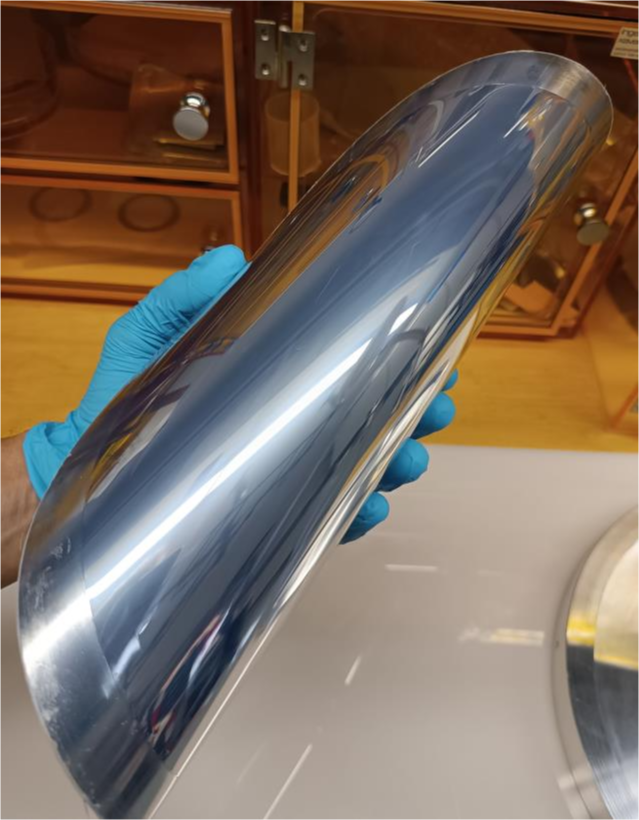
Dr Sebastian Rabien and his colleagues have developed a technique to fabricate thin but precisely shaped mirrors that are flexible enough to even be rolled up and stored on a launch spacecraft before being deployed. These membrane mirrors are parabolic, giving them a curved shape which focuses incoming light to the focal point of the mirror.
Fabricating Membrane Mirrors
To fabricate these mirrors, Dr Rabien and his team use a fabrication technique called chemical vapour deposition – this involves heating up a substrate within a chamber and then injecting a gas which then reacts or breaks down on the substrate’s surface to create a very thin layer of material. Dr Rabien’s process uses a polymer called parylene, which is highly stable and can be used at a wide range of temperatures, making it suitable to be used in space.
To test and refine this process, Dr Rabien and his team set up a custom deposition chamber. The dimer, or solid form of the substance that will become a gas in the chamber, is heated. The molecules then pass into a pyrolyser that breaks the dimer down further. This gas is then injected into the main chamber using a distribution tube, which showers the mandrel with the gas to create a uniform layer of parylene.
Dr Rabien’s process deposits the parylene onto a rotating liquid mandrel. By using this rotating liquid to shape their mirror, they can form the desired parabolic surface. Whilst depositing the material to make the mirror onto the liquid, they keep the system in a vacuum as required by the process, but as well to prevent air turbulence around the liquid as it spins, and to keep out any dust particles. This liquid needs to be high viscosity (to minimise vibrations), and soluble (so that it can be removed from the parabolic mirror surface after deposition).
The team used a range of different liquids to form the mirror, making samples of each and comparing them by seeing how they transmit and reflect an incident laser beam. From these measurements, they can estimate how rough the surface of the mirror is – we want the mirror surface to be as smooth as possible for optimal performance. Dr Rabien found that high viscosity vacuum compatible liquids that result in polymer films smooth enough to be used for the optical purpose.
The team tested this process by making 30-cm diameter mirrors, which are only around a hundred microns thick, or about as thick as one or two strands of human hair, and found that there are some border effects in the growth process, where the border has a steeper gradient than expected. They examined these by looking at the reflections from a laser beam shone onto the surface, to find out more about the gradient of the mirror during the fabrication process. Dr Rabien and his colleagues believe that this effect is the result of a change in surface tension from initially having a liquid next to a solid in a vacuum, which then transforms into having a liquid next to a solid next to another solid as the mirror forms. This surface tension effect can be minimized by matching the amount of liquid exactly to the available volume.
This fabrication process results in membrane mirrors which are so thin and flexible that they can be rolled up – this makes larger space telescopes easier to package compactly, so they can fit on a spacecraft. The team test and demonstrate how this could be carried out, including suggesting binding a triangular membrane to the mirror (attached to a pyramid-shaped metal structure), so the edges of the triangle can be folded away, and then pulled out to restore the mirror’s shape.
Accounting for Mirror Deformation
One of the challenges of fabricating and deploying mirrors for use in space telescopes is ensuring that they have minimal deformations or flaws in their final placement in the telescope, as this interferes with the quality of the images and data they return. For Dr Rabien’s mirror, these deformations could occur in the unrolling process when the mirrors are deployed, or they could be due to changes in the gravitational conditions. To correct for them, the team have devised a method that uses the thermal expansion properties of the mirror’s material to overcome this.
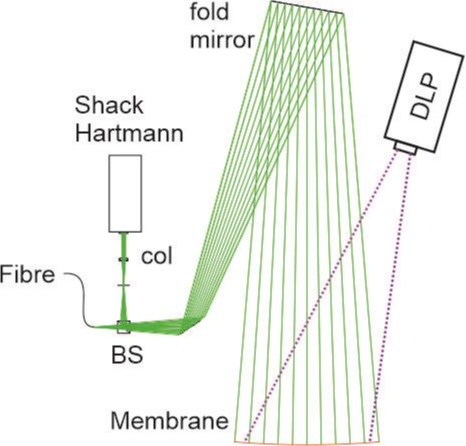
This method involves illuminating different parts of the mirror’s surface by placing a light source, such as a digital light projector, on the side of the mirror opposite to the incoming light. If the membrane mirror absorbs the light, it causes the temperature to increase, and the material expands. This material expansion causes a local decrease in the radius of curvature of the mirror. To tune the shape of the mirror, Dr Rabien’s team use a global radiation bias – this means that there is some illumination across the entire surface, so increasing the radiation can cause material expansion, and reducing it can cause contraction. Light coming into the mirror can then be measured using a wavefront sensor, which uses an array of lenses to focus the light onto a set of detectors that observe any aberrations coming from deformations in the mirror. This information can then be fed into a controller, which alters the illumination at the digital light projector, creating a feedback loop which optimises the mirror’s surface.
Adaptive Control of the Mirror’s Surface
Dr Rabien’s team have simulated the mirror’s response to different illuminations to optimise the power of the incident light, the radius of the spot of light hitting the mirror, and how thick the membrane mirror should be. Then, they create a test set-up in the lab, placing the mirror on an aluminium rest and shining laser light at the mirror, to collect the reflected light on a wavefront sensor. This wavefront sensor focuses the light onto an array of lenses, each forming a spot on a detector, allowing the researchers to detect any tilts or inconsistencies in the profile of the reflected light. To calibrate their set-up, the team initially apply pre-defined deformations to the mirror so that they are able to compare their measurements of this on the wavefront sensor to the expected deformations from these shapes.
From this set-up, Dr Rabien works on correcting for global deformations in the system as well as correcting for the aberrations introduced by the mirror’s surface. In their set-up in the lab, a source of deformation is the aluminium rest which the mirror is placed on. As the mirror sits on this rest, there is a global deformation across the mirror. So, to tune their experimental set-up, the team thermally create two indentations on the mirror at sites of known distance, and then calculate how much the image from the projector gets magnified when it’s shone onto the mirror. The team use a mathematical model with influence functions, to predict how this affects the outcomes of the test set-up.
Dr Rabien and his colleagues closely monitor the mirror shape. They do this by considering a set of mathematical functions called the Zernike polynomials, which can be used to quantify the aberrations in the mirror. They also look at the mirror’s shape over time, helping to assess its stability within an optical system. By combining these calibrations with their test set-up, Dr Rabien’s team can correct for shape deviations resulting in an optical surface quality of order 15nm (which is ~0.015 micron), using their light source and feedback system with the membrane mirror.
Overall, Dr Rabien’s work offers new possibilities for creating large space telescopes in the future. From the development of a fabrication process using a rotating liquid to create a parabolic shape, through to being able to adaptively correct for imperfections by illuminating the membrane mirror, Dr Rabien and his colleagues have demonstrated not only how to create and test these mirrors, but also considered how they can be rolled up and function in the extreme conditions of space. With thin, flexible, and corrective mirrors like these, it’s exciting to think about the future discoveries that could be made with larger space telescopes!
SHARE

DOWNLOAD E-BOOK
REFERENCE
https://doi.org/10.33548/SCIENTIA1299
MEET THE RESEARCHER
Dr Sebastian Rabien
Max Planck Institute for Extraterrestrial Physics, Munich, Germany
Dr Sebastian Rabien initially obtained his physics degree from the Technical University of Munich, Germany in 1999, before moving to the Ludwig Maximillian University in Munich to study for his PhD. During his doctoral studies, Dr Rabien worked as part of the Infrared Astronomy group at the Max Planck Institute for Extraterrestrial Physics and as part of the European Southern Observatory (ESO). Following the completion of his PhD in 2004, Dr Rabien has continued to work at the Max Planck Institute for Extraterrestrial Physics as a Scientist in Infrared Astronomy, and he continues his research here today. His work here includes research into optical and laser systems for telescopes and observatories, adaptive optics and control for these systems, and recently how we can fabricate membrane mirrors with adaptive optical control for future space telescopes. His work has been widely published in his field and featured both within scientific conferences and reported by the wider media.
CONTACT
E: srabien@mpe.mpg.de
KEY COLLABORATORS
Lorenzo Busoni, INAF, Arceti Astrophysical Observatory, Florence, Italy
Ciro Del Vecchio, INAF, Arceti Astrophysical Observatory, Florence, Italy
Julian Ziegleder, Max Planck Institute for Extraterrestrial Physics, Germany
FURTHER READING
S Rabien, Adaptive parabolic membrane mirrors for large deployable space telescopes, Applied Optics, 2023, 62, 11, 2835, DOI: https://doi.org/10.1364/AO.487262
S Rabien, L Busoni, C Del Vecchio et al, Membrane Space Telescope: Active Surface Control with Radiative Adaptive Optics, Proc. SPIE 13092, Space Telescopes and Instrumentation 2024: Optical, Infrared and Millimeter Wave, 130925O, DOI: https://doi.org/10.1117/12.3019682


REPUBLISH OUR ARTICLES
We encourage all formats of sharing and republishing of our articles. Whether you want to host on your website, publication or blog, we welcome this. Find out more
Creative Commons Licence (CC BY 4.0)
This work is licensed under a Creative Commons Attribution 4.0 International License. 
What does this mean?
Share: You can copy and redistribute the material in any medium or format
Adapt: You can change, and build upon the material for any purpose, even commercially.
Credit: You must give appropriate credit, provide a link to the license, and indicate if changes were made.
SUBSCRIBE NOW
Follow Us
MORE ARTICLES YOU MAY LIKE
Sara F Martin | The New Paradigm: Two Fundamental 22-year Solar Cycles Always Present on the Sun
For millennia, humans have looked up towards the life-giving Sun and sought to understand its nature. One of its earliest features noticeable before the age of technology was the presence of small dark patches scattered across its surface – sunspots. These blemishes appeared to wax and wane on a regular 11-year cycle, which was thought for over a century to be a fundamental time period governing the Sun’s magnetic activity. But new discoveries suggest a radically different understanding where sunspots are merely peak phases of two, more fundamental 22- year magnetic cycles present simultaneously in different bands of latitude.

Professor Tian Yu Cao | Twistor Theory: A New Framework for Quantum Gravity
At Boston University, Professor Tian Yu Cao is rethinking the foundations of modern physics. His work builds on twistor theory which demonstrates that spacetime is secondarily derived from twistor constructions, but goes further to highlight the most important implication of the Penrose transform in that the primary physical agents can only be mathematically described by elements of cohomology with the defining feature having roots in spin. This view of primary agents combines with Cao’s other major claim that quantum behaviour itself may arise from the physical property of spin leads to a new consistent framework of quantum gravity in which long-standing puzzles in black holes (evaporations) and cosmology (transitions between cycles of cosmos) can be adequately addressed, with the crucial help from the on-going development of operator product expansion formular defined on twistor space.
Professor Mikhail V. Medvedev | Plasma Waves in Extreme Magnetic Fields: Exploring the Quantum Regime
In environments where magnetic fields exceed even the limits of classical physics, such as magnetars and next-generation laser experiments, plasma behaviour is fundamentally altered by quantum effects. Professor Mikhail V. Medvedev and colleagues have developed a framework to understand how these extreme conditions reshape plasma waves, revealing that while familiar wave structures persist, their properties are significantly modified. These insights provide a foundation for interpreting astrophysical observations and advancing high-energy plasma experiments.

Alex Spezowka | Responsible Research Writing in the Age of AI: From Detection to Transparency
Artificial intelligence is often discussed as a future challenge for research, yet it is already shaping how many papers are written. Drawing on emerging evidence and recent analysis, work led by Alex Spezowka highlights a key shift in thinking: rather than trying to detect AI use, the focus is moving towards how it can be used responsibly. This has important implications for how research is produced, evaluated, and trusted.