
As the practice of psychotherapy increasingly embraces the spiritual dimensions of the human experience, therapists are investigating new ways to weave faith and meaning into healing. Dr Suzanne Coyle, a licensed pastoral counsellor and family therapist, explores the role of spirituality in psychotherapy and how this intersection can support the journey of healing. Her work provides practitioners with the tools and knowledge to integrate spirituality meaningfully into clinical practice.
Uncovering Spirituality in Therapy: A New Frontier in Healing
Over the past few decades, psychotherapy has evolved beyond the traditional couch-and-notebook stereotype to become a richer, more holistic exploration of human experience. One development has been the incorporation of religion and spirituality into therapy. As more people describe their mental health challenges in spiritual as well as emotional terms, psychologists and counsellors have begun to consider the role of spirituality in healing. Spirituality refers to the human search for meaning and purpose in life through being part of something larger than oneself. Integrating this dimension into psychotherapy allows people to bring their full selves into the room: body, mind, and spirit.
Dr Suzanne Coyle has been at the forefront of this movement. In her 2024 publication, ‘A Case Study Method for Integrating Spirituality and Narrative Therapy’, she demonstrates how spirituality can naturally emerge in therapy through storytelling —not as a doctrine imposed by the therapist, but as meaning discovered by the client. Her approach draws on two profound theological ideas: immanence and transcendence. Immanence refers to the divine presence within everyday life, the sacred woven through ordinary moments, pain, and struggle. It reminds us that spirituality is not reserved for the mountaintop or the monastery; it is present in the messiness of living. Transcendence, by contrast, is the sense that the divine is separate from physical existence; it refers to moments or experiences that lift a person beyond their ordinary limits, pain, or suffering. Dr Coyle argues that both are essential: immanence grounds us in our humanity, while transcendence invites us to imagine more.
Jasmine’s Journey: Lessons from a Composite Case Study
To illustrate how spirituality and therapy can meet in practice, Dr Coyle uses a composite case study which, unlike a typical clinical case drawn from one person’s experience, combines stories, patterns, and themes from several real clients. This protects confidentiality while allowing the therapist to explore complex issues that arise across multiple lives. It is part creative synthesis, part teaching tool to shows how theory works in the real world.
Dr Coyle’s composite client is called ‘Jasmine’. She embodies struggles that are relatable for many people: buried trauma, simmering anger, and a longing for peace. Jasmine, a woman in her late twenties, came to therapy after years of abuse, both in childhood and adult relationships. Her unpredictable and often explosive anger began to threaten her work and friendships. Beneath that anger, Dr Coyle discerned not only pain but a yearning for meaning.
In therapy sessions, Jasmine gradually began to tell her story—a childhood shadowed by violence, a teenage flight into a troubled marriage, and a growing sense that anger had taken on a life of its own. Notably, Dr Coyle listens for what is not said to uncover the ‘absent but implicit’ story. For example, when Jasmine spoke of hiding under the bed as a child, Dr Coyle heard both fear and courage. The therapist’s role was not to fix Jasmine’s anger, but to help her re-story her life in a way that gave her agency and hope.

Rewriting the Story: Narrative Practice and Spirituality
Narrative therapy is the foundation of Dr Coyle’s approach and begins with a simple belief that people are not the problem; the problem is the problem. Rather than seeing clients as broken or disordered, narrative therapists see them as storytellers caught in limiting narratives. Through conversation, clients are invited to externalise the problem and to re-story their stories with richer, more empowering meanings.
In Jasmine’s case, this meant separating ‘anger’ from her identity. Dr Coyle asked questions such as, ‘When does anger show up?’ and ‘What happens when you stand up to it?’. These questions gave Jasmine space to see herself as someone who could interact with her emotions, rather than be consumed by them. As their conversations deepened, spiritual language began to surface naturally. Jasmine described prayer as her ‘weapon’ and church as her ‘haven of rest’. Here, spirituality was not imposed but emerged from the story itself. In narrative therapy, these moments of meaning are gently nurtured through techniques such as scaffolding –guiding the client to take one small step beyond what feels possible, and thickening the story –helping them to see multiple layers of identity beyond trauma or pain.
For Jasmine, prayer became a counter-story to fear and anger. Through faith, she could imagine herself as brave and beloved rather than broken. Her spirituality gave her a sense of transcendence while still honouring the immanence of her everyday life.

Healing Dialogue: Integrating Spirituality in Clinical Practice
Dr Coyle’s approach does not blend theology and psychology into a single system; instead, it stages a conversation between them. The therapist begins with the client’s presenting concern, such as anger, grief, or anxiety, and explores it through therapeutic tools like externalising or re-authoring. As spiritual themes emerge, they are brought into dialogue with theological concepts like immanence and transcendence. In Jasmine’s case, anger represented the raw, earthly side of existence, but through prayer and community, she gained a sense of transcendence –the possibility of freedom, connection, and hope.
This approach requires sensitivity. Therapists must avoid prescribing beliefs or assuming that spirituality means religion. Instead, Dr Coyle suggests, they can ask open questions that allow clients to define spirituality in their own terms.
Integration also means recognising limits. Not every session will end in revelation, and not every client will find solace in faith. Dr Coyle notes that Jasmine’s life remained imperfect; anger and hardship did not vanish. Yet, therapy offered her a sense of continuity between her suffering and her spirituality. By weaving immanence and transcendence together, Jasmine could live within her story rather than be trapped by it.
Dr Coyle’s framework ultimately invites all therapists to see healing as a conversation of perspectives. Psychological methods uncover emotional patterns; spiritual reflection opens possibilities of meaning. When these perspectives meet, they form what she calls a ‘both/and’ understanding, one that holds human limitation and divine possibility in the same compassionate gaze.

Stories That Heal: Finding Hope Beyond the Hurt
Dr Coyle’s work reveals that psychotherapy and spirituality are not opposing disciplines but partners in understanding what it means to be human. Storytelling becomes the bridge through which people make sense of their past, find language for pain, and glimpse the sacred in their survival. In the end, Jasmine’s story is one of transformation. By learning to see her anger as a visitor rather than an identity, and her prayer as a path rather than an escape, she found a more hopeful narrative. For readers and practitioners alike, Dr Coyle’s work demonstrated that therapy can be a sacred space, and spirituality can be therapeutic.
SHARE

DOWNLOAD E-BOOK

LISTEN TO THE AUDIO
REFERENCE
https://doi.org/10.33548/SCIENTIA1338
MEET THE RESEARCHER

Dr Suzanne Coyle
School of Counseling, Christian Theological Seminary, Indianapolis, IN, United States
Dr Suzanne Coyle obtained her PhD in Pastoral Theology and Communications from Princeton Theological Seminary and completed clinical training at the Ackerman Institute for the Family in New York. Currently, Dr Coyle works as a Professor of Pastoral Theology and Marriage and Family Therapy and Director of the Marriage and Family Therapy Programme at Christian Theological Seminary. She has authored several books and peer-reviewed publications which explore the integration of spirituality, theology, and narrative practice within psychotherapy and pastoral care, focusing on how storytelling, faith, and systemic family therapy can foster healing and hope across diverse personal, cultural, and religious contexts.
CONTACT
E: scoyle@cts.edu
W: www.spiritualnarratives.com
FURTHER READING
Coyle SM (2024) A Case Study Method for Integrating Spirituality and Narrative Therapy. Religions 15; 381. https://doi.org/10.3390/rel15030361
Coyle SM (2017) Integrating Spirituality in Marriage and Family Therapy Training. Australian and New Zealand Journal of Family Therapy 38, 142–155. https://doi.org/10.1002/anzf.1195
Coyle SM (2013) Re-storying Your Faith. John Hunt Publishing.
Coyle SM (2022) Spirituality in Systemic Family Therapy Supervision and Training. Springer Nature, https://doi.org/10.1007/978-3-030-92369-3
Coyle SM (2023) Spiritualität in Supervision und Ausbildung der Systemischen Familientherapie. Springer Nature.
Coyle SM (2014) Uncovering Spiritual Narratives: Using Story in Pastoral Care and Ministry. Augsburg Fortress Publishers. https://doi.org/10.2307/j.ctt22nm7hf
REPUBLISH OUR ARTICLES
We encourage all formats of sharing and republishing of our articles. Whether you want to host on your website, publication or blog, we welcome this. Find out more
Creative Commons Licence (CC BY 4.0)
This work is licensed under a Creative Commons Attribution 4.0 International License. 
What does this mean?
Share: You can copy and redistribute the material in any medium or format
Adapt: You can change, and build upon the material for any purpose, even commercially.
Credit: You must give appropriate credit, provide a link to the license, and indicate if changes were made.
SUBSCRIBE NOW
Follow Us
MORE ARTICLES YOU MAY LIKE

Dr Roustem Miftahof – Dr Fred Makaroff | Love Your Brain Like Your Body – Use Neurolytics©
Brain and mental disorders are conditions that disrupt how the brain works, affecting how people think, feel, or behave. The current insufficient approach to diagnosing these conditions has contributed to their massive global impact. By 2050, an estimated 4.9 billion people will suffer from neurodegenerative disorders and mental illnesses.
At Advanced Biosimulation Technologies LLC (USA), scientists and engineers led by Dr Roustem Miftahof and Dr Fred Makaroff have developed a groundbreaking platform designed to screen and detect early cognitive changes before symptoms appear.
Dr Eun Jin Jung | Getting sufficient sleep improves the life satisfaction of adolescents
Insufficient sleep can cause much more than tiredness and grouchiness in adolescents. As well as being important for their health, adolescents also need to get enough sleep to feel satisfied with their lives, according to a study by Dr Eun Jin Jung, from the Centre for Regional and Industrial HRD Research, Korea Research Institute for Vocational Education and Training, Sejong, Republic of Korea.
Dr Bo Song | Light, Energy, and the Living Nerve
At University of Shanghai for Science and Technology, recent work by Professor Bo Song and colleagues suggests that light may play an unexpected role in the way our nerves use and transmit energy. Their research explores how mid-infrared photons, tiny packets of light released by chemical reactions inside nerve cells, might interact with the fatty myelin sheath tasked to insulate axons. Together, the studies propose a new view of biological communication —one that combines chemistry, physics, and quantum mechanics— to explain how the nervous system could use light to enhance energy efficiency and information transfer.
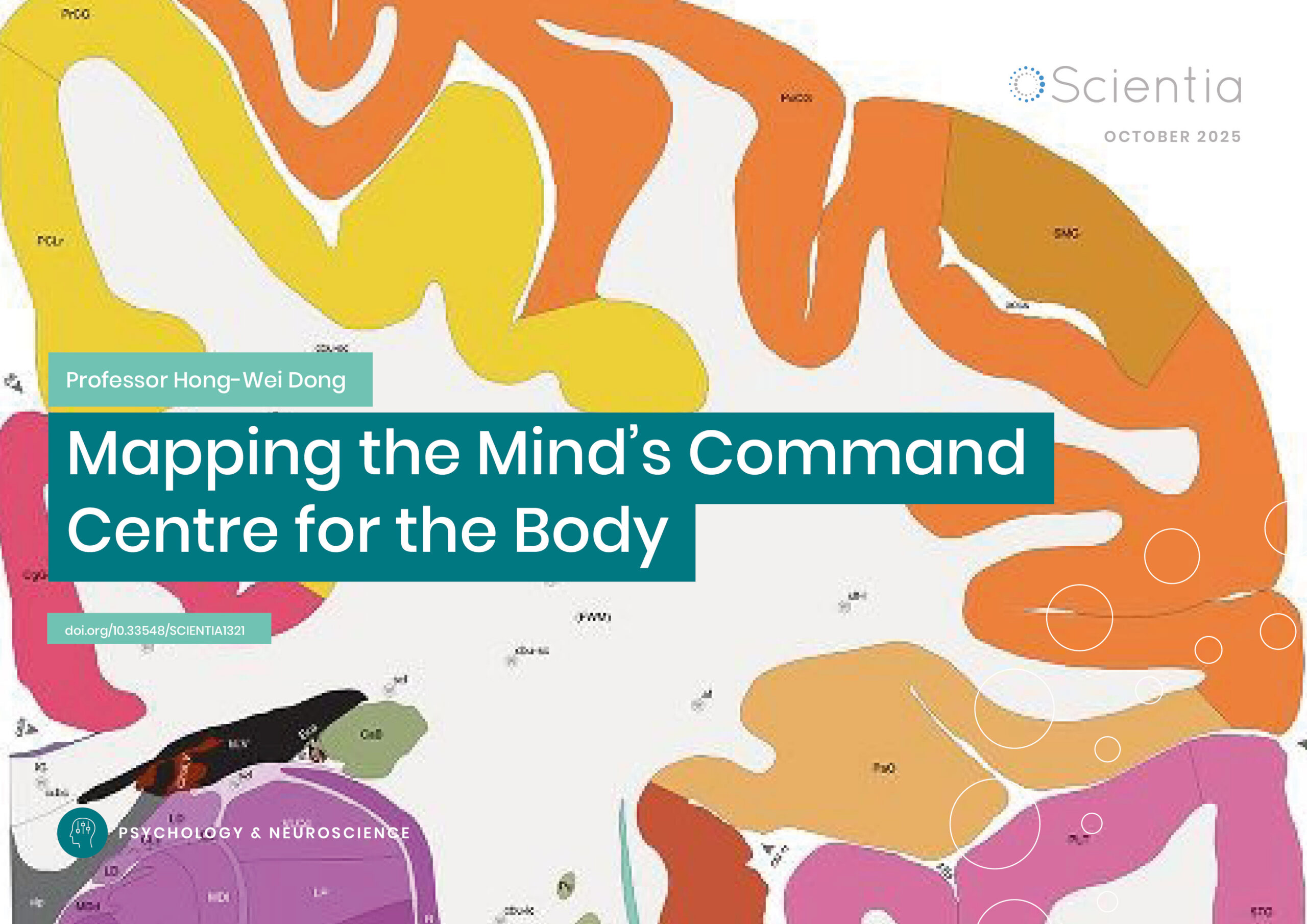
Professor Hong-Wei Dong | Mapping the Mind’s Command Centre for the Body
The brain’s ability to manage stress and guide behaviour, including making decisions or interacting with others, relies in part on an area called the medial prefrontal cortex. But exactly how this region controls the body’s internal responses has remained unclear. New research on mice led by Prof Hong-Wei Dong and his team at the University of California Los Angeles (UCLA) sheds light on a little-studied part of the brain that may play a key role.
The work reveals a complex network, unconvering a previously undefined “primary visceromotor cortex” in the mouse brain, that helps link thoughts, feelings, and physical state. This discovery could reshape our understanding of how the brain controls stress, emotion, and internal bodily functions, and offer new insights into human mental health disorders.