
Ohio Wesleyan University’s geological collection, which was amassed in Delaware, Ohio, USA, is among the oldest in America, but decades after those who assembled the collection retired and passed on, the collection fell into obscurity and its storage area was repurposed. Prof Loren Babcock, Director of the Orton Geological Museum at The Ohio State University, is leading a 3-year rescue project to stabilise, catalogue, and digitise more than 15,000 specimens. From rediscovered scientific-name-bearing type fossils to ethically sourced collections linked to abolitionist networks, the initiative promises not only to safeguard irreplaceable scientific material, but to revive a once overlooked foundation of American geology for future generations.
Significant Specimens
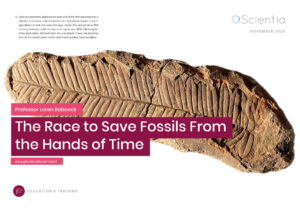
In the basement of Ohio Wesleyan University’s (OWU’s) science building, beneath decades of dust, sat one of the most extraordinary geological collections. More than 15,000 fossil, mineral, and rock specimens, many dating back 390 million years to the Devonian Period, have a unique history that is beginning to feel the strain of time. Primarily collected in the 1830s to 1860s, and now under the care of Dr Loren Babcock, Professor and Director of the Orton Geological Museum at The Ohio State University, OWU’s geological collection symbolises the infancy of palaeontology in America. However, almost two hundred years later, paper labels are crumbling, cardboard specimen trays are decomposing, and with them, crucial information about America’s earliest geological investigations is disappearing.
This isn’t just another forgotten university collection. Among these deteriorating specimens are fossil plants from Ohio and Illinois documented in America’s earliest geological reports, dinosaur tracks from Massachusetts, and many of the earliest-reported fish fossils from North America, which were long thought lost to science. The collection represents the work of some of America’s most eminent 19th century geologists, ones who helped build the foundations of American geology during the Industrial Revolution, including William W. Mather, John Strong Newberry, Edward Orton, James Hall, Leo Lesquereux, Edward Hitchcock, James Dwight Dana, and Ferdinand V. Hayden. Some of the specimens were collected at the direction, or with the political backing, of US presidents Abraham Lincoln, Ulysses S. Grant, and Rutherford B. Hayes.
Now, the Orton Geological Museum at The Ohio State University has received a comprehensive proposal to protect this collection. The 3-year project would transfer specimens from temporary storage and house them in proper archival conditions while cataloguing the entire collection, making it publicly accessible through digital databases and exhibitions. This project will not only rescue an irreplaceable scientific collection but transform it into a source of research, wonder, and public engagement. The work of researching the collection and applying it in teaching and outreach has begun already.

A 50-cm Devonian chondrichthyan (“shark”), Cladoselache fyleri, preserved in a carbonate concretion and showing a microbial “decay halo;” from the Cleveland Shale Member of the Ohio Shale (Devonian) in Cleveland, Ohio. This specimen was collected by Wiiliam Kepler between and 1860 and 1868. This fossil chondrichthyan was the centrepiece of an art/palaeontology exhibition entitled “Fossils and Halos,” organized by Camilla Querin. This exhibition featured original works of art by OWU faculty artists Kristina Bogdanov, Frank Hobbs, and Jeff Nilan that were inspired by the fossil.
Rediscovering Lost Treasures
Several distinctive features make this collection unlike many others. In palaeontology, type specimens are the original physical examples used to describe a new species. They’re essentially the gold standard, acting as the reference point against which all future identifications are made. For decades, numerous type specimens from John Strong Newberry’s seminal work on Devonian and Jurassic fishes were presumed lost. Newberry was a a leading 19th-century geologist who published fish fossil descriptions that represented some of the earliest work on ancient vertebrates in North America. Those “lost” specimens? They’ve been rediscovered in the OWU collection. This isn’t just historically interesting; these specimens remain scientifically relevant today, as researchers continue to refine our understanding of vertebrate evolution.
The challenge now is identifying all the type specimens in the collection before it’s too late. Some have paper labels or small tags glued to them indicating their scientific status, and others just have distinctive paint spots. But some have lost all associated details and can only be identified by painstakingly matching them to published illustrations and descriptions. It is important but time-consuming work, but with the paper information associated with the specimens crumbling and disappearing, time has become a precious commodity.
Ethically Sourced Specimens
There’s another element to this collection that makes it potentially unprecedented in museum history. Rev Dr Frederick Merrick, who was the second president of OWU and the museum’s founder, didn’t just collect specimens, he forged relationships with specific scientists, collectors, and politicians, all of whom shared a particular set of values. It appears that every major contributor to the OWU Geology Museum was connected to the abolitionist movement in the pre-Civil War era, and most continued as advocates for expanding civil rights afterward— a remarkable characteristic considering the prevailing attitudes of many leading scientists at the time.
This raises the fascinating possibility that the OWU Geology Museum collection may be one of the earliest instances of any natural history collection assembled with ethical considerations in mind, which is unfortunately seldom seen in today’s western world.

Left: Woodcut from J.S. Newberry (1853), a composite illustration showing two teeth of the lobe-fin fish Onychodus sigmoides. The larger tooth is the one illustrated on the right (image reversed in the woodcut). This is the lectotype of the species.
Right: Tooth of a giant lobe-finned fish, Onychodus sigmoides, from the Devonian of Delaware, Ohio. This species was illustrated in 1853 and described in 1857 by John Strong Newberry, based on this and one other tooth. This tooth is 5.5 cm long. Lobe-finned fishes are of evolutionary importance, as they gave rise to landdwelling vertebrate animals.
The Current Crisis
The collection has faced many threats over 150 years or more. After decades in Merrick Hall (1873–1970), it was shifted to basement storage as the museum slipped into obscurity. By the 1980s, some fossil fishes were sent to the American Museum of Natural History, and type specimens were thought lost.
Then, in 2023, OWU began preparing new laboratory and teaching spaces, and the collections came under imminent threat. Specimens were urgently transferred to the Orton Geological Museum between between 2023 and 2024. While this emergency relocation prevented the worst outcome, most of the collection materials now remain in interim storage, stacked in outdated drawers and continuing to deteriorate.
A condition assessment identified multiple critical issues. There’s no general catalogue of the collection and most specimens are unnumbered; if a catalogue ever existed, it’s now lost, making the determination of their geographic and stratigraphic provenance highly challenging. Paper labels made from sulphide-bearing materials are crumbling and actively damaging specimens through sulphuric acid formation, which is particularly problematic for carbonate rocks like limestone. Iron sulphide minerals in both specimens and storage materials are suffering from pyrite disease, causing specimens, labels, and trays to break down. Also, the interim storage lacks proper environmental controls.
The 3-Year Rescue Plan
Prof Babcock’s project is comprehensive and methodical. Year 1 focuses on refurbishing a large storage room in Orton Hall, which is Ohio State’s geological museum building, to house the specimens, hiring a curatorial assistant and student workers, and beginning to move specimens from temporary storage, while conserving and cataloguing them. This will involve studying comparative specimens in other museums such as the American Museum of Natural History. In the 19th century, it was common practice to split fossils into part and counterpart slabs and place them in different collections, so some of the OWU specimens likely have matching halves in New York, assisting in their identification.
Year 2 continues the curation work and begins public engagement. Year 3 completes the curation, creates a digital catalogue for web access, continues public exhibitions and conference presentations, and deposits archival records at Ohio State, Ohio Wesleyan, and the Ohio Division of Geological Survey. This project will foster collaboration between these three institutions, as they maintained close connections in the 19th century. Educational value is also built into the project, as students will develop research projects from the collection and learn museum curatorial procedures.
The budget combines federal and institutional support, covering archival materials, digital storage, and new specimen cabinets. The OWU collection will have dedicated cabinets, with all specimens rehoused in acid-free labels and trays. Original labels will be preserved in archival envelopes, and each specimen will be digitally photographed. This transformation of storage, documentation, and access will give the collection and its research potential a new lease on life.
No Time Like the Present
Collections like this are irreplaceable resources. They’re not just objects, but sources of scientific data that can be reanalysed with new techniques, such as modern imaging, geochemical analysis, and computational methods — answering questions that couldn’t even be imagined when the specimens were first collected. But quality science requires preserved specimens.
The Orton Geological Museum has the expertise, facilities and the institutional commitment to provide permanent, professional care for this collection. This project isn’t just about safekeeping old museum objects for academic research, it’s about preserving the material foundations of American science, recovering lost type specimens, and documenting what may be one of the earliest ethically-curated natural history collections in existence. It’s about making 15,000 specimens widely accessible so they do not become lost to science and history. The clock is ticking, but with adequate support, this remarkable collection can be saved, studied, and shared for generations to come.
SHARE

DOWNLOAD E-BOOK
REFERENCE
https://doi.org/10.33548/SCIENTIA1337
MEET THE RESEARCHER
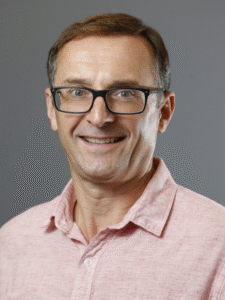
Prof Loren E. Babcock
Orton Geological Museum
School of Earth Sciences
The Ohio State University
155 South Oval Mall
Columbus, OH 43210, USA
Loren Babcock is Professor of Earth Sciences and Director of the Orton Geological Museum at The Ohio State University. A leading figure in palaeontology and stratigraphy, his research focuses on Paleozoic fossils, Cambrian geology, fossilisation processes, and evolutionary palaeobiology, with particular expertise in trilobites and the Ediacaran-Cambrian transition. From 2012 to 2020, he chaired the International Subcommission on Cambrian Stratigraphy, guiding the global effort to define and ratify stages and series of the Cambrian System.
He has published more than 240 scientific papers and authored or edited 13 books, including the widely used textbook Visualising Earth History. Beyond research, Prof Babcock has advanced education through innovative museum training programmes, STEM enrichment for under-represented students, and public engagement initiatives such as the Megalonyx Project. His achievements have been recognised with multiple honours, including the Charles Schuchert Award, the Erasmus Haworth Award, and several recent Best Researcher Awards in Earth and Planetary Sciences, Global Research, and Network Science.
CONTACT
E: babcock.5@osu.edu
W: https://earthsciences.osu.edu/people/babcock.5
ORCID: https://orcid.org/0000-0002-9324-9176
KEY COLLABORATORS
John B. Krygier, Laurel J. Anderson, and Camilla Querin from Ohio Wesleyan University
D. Mark Jones from Ohio Geological Survey
FUNDING
This work is funded by the Department of the Interior’s Save America’s Treasures Program, administered through the National Park Service (Grant/Cooperative Agreement #P25AP01904-00), and a grant from the Battelle Engineering, Technology, and Human Affairs Endowment Fund (GF600375).
FURTHER READING
LE Babcock, Rediscovery of the type specimens of the sarcopterygian fishes Onychodus sigmoides and Onychodus hopkinsi from the Devonian of Ohio, Diversity, 2025, 17, 6, 375, 1–20, DOI: https://doi.org/10.3390/d17060375
LE Babcock, Type crania of the Devonian placoderm Macropetalichthys from North America: Resolving key nomenclatural and stratigraphic conundrums, Fishes, 2025, 10, 7, 309, 1–20, DOI: https://doi.org/10.3390/fishes10070309
LE Babcock, DF Kelley, JB Krygier, WI Ausich, DL Dyer, DM Gnidovec, AM Grunow, DM Jones, E Maletic, C Querin, HG McDonald, DJ Wood, Collections for the public good: A case study from Ohio, Diversity, 2025, 17, 6, 392, 1–23, DOI: https://doi.org/10.3390/d17060392
LE Babcock, Some vertebrate types (Chondrichthyes, Actinopterygii, Sarcopterygii, and Tetrapoda) from two Paleozoic Lagerstätten of Ohio, U.S.A., Journal of Vertebrate Paleontology, 2024, 44, e2308621, DOI: https://doi.org/10.1080/02724634.2024.2308621


REPUBLISH OUR ARTICLES
We encourage all formats of sharing and republishing of our articles. Whether you want to host on your website, publication or blog, we welcome this. Find out more
Creative Commons Licence (CC BY 4.0)
This work is licensed under a Creative Commons Attribution 4.0 International License. 
What does this mean?
Share: You can copy and redistribute the material in any medium or format
Adapt: You can change, and build upon the material for any purpose, even commercially.
Credit: You must give appropriate credit, provide a link to the license, and indicate if changes were made.
SUBSCRIBE NOW
Follow Us
MORE ARTICLES YOU MAY LIKE

Professor Richard Ludueña | Two Turkish Cities Were Essential in the Development of Science and Religion – a Work in Progress
This book explores the history of the area in Turkey where these two cities lie. Prof Richard Ludueña and his daughter visited Harran and Sanliurfa (formerly Edessa) in 2014. He found them fascinating and wanted to learn more about their histories, but found no book that focused on their history from the beginning to modern times. So, he decided to write one.
Harran still bears its ancient name, but Edessa has had a great variety of names and is now called Sanliurfa. Our story goes back long before the cities were founded, back to the late Neolithic site of Göbekli Tepe, where monuments have carvings consistent with a destructive comet.
Professor Dilip Kumar | From the Ground Up: The Making of a Modern Mathematics Centre in Kerala
In 1977, Professor Aleyamma George, head of statistics at Kerala University, dreamed of establishing a new centre for mathematical sciences in Kerala’s coastal capital Trivandrum. Her mission was to encourage talented young mathematicians to engage in frontline research in the mathematical sciences. But, for many years, it struggled to obtain regular government funding and survived only because of the Herculean efforts and personal funds of both Prof George and its Director since 1985, Professor Arak Mathai.
Later, it supported the operations of eight different dedicated research groups producing award-winning work, and regularly hosts undergraduate-level workshops; it fulfilled the original mission of training and educating new generations of mathematicians, so that they may contribute to cutting-edge, internationally recognised research.
Professor Jun Tsuji – Professor Steven Wathen | SHAPE STEM: Building a Sustainable Future through STEM Education
The SHAPE STEM program at Siena Heights University is transforming how students engage with science, tackling urgent environmental challenges in Michigan while preparing the next generation of problem-solvers. Led by Professor Jun Tsuji and Professor Steven Wathen, the program combines research, mentorship, and financial support to help low-income and underrepresented students thrive in STEM, with outcomes that ripple far beyond the classroom.

Professor Hans Haubold – Professor Arak Mathai | A Summer House and the Sun: 50 Years of Space Science with the UN
From a summer house just outside of Berlin, to the establishment of educational centres across the world —Professors Hans Haubold and Arak Mathai have overseen the remarkable development of space science over the last half-century. Their early research into the curious solar neutrino problem in the 1970s spawned several books and a large volume of academic literature exploring the inner workings of our Sun.
Developments in the mathematics of fractional calculus and special functions then helped to facilitate extensive studies of space and our solar system. Over the last 30 years, under the umbrella of the United Nations, space science has boomed, with 7 new centres set up across the globe and over 20 dedicated workshops arranged. A new generation is being trained to tackle the mysteries and challenges presented to us by outer space.