
Featured writer: Laura Hemmingham

My first find at a cave excavation in Somerset: a 45,000-year-old bison radius. July 2023.
I’m a scientific content producer with a strong academic background in zoology, environmental science, and ecology. I hold a PhD in palaeoecology, and throughout my academic and professional journey, I’ve focused on making science accessible and engaging for a wide range of audiences.
Over the course of my career so far, I’ve produced diverse scientific content, including articles for Scientia, newsletters with the Conservation Paleobiology Network, and e-learning material for Stairway Learning. Whether I’m distilling a complex journal article or building an educational resource, my goal is always the same: to make science clear, engaging, and useful. I particularly enjoy writing content focused on conservation, especially when I can highlight the value of long-term records, such as fossil data capturing species’ past distributions and ecological roles, to understand where and how they once lived. Conservation palaeobiology uses these insights to support modern biodiversity and conservation efforts, since knowing aspects of past life is key to truly understanding the current status of species and their future resilience.
Currently based in the UK, I work as a Scientific Content Producer for Technology Networks. In this role, I get the opportunity to interview a range of scientists working in diverse fields in the life sciences and write on an array of topics.
Do you have a preferred place to write, or time of day? What does a day in the life of a science writer like you look like?
I’m quite a routine-driven writer, so I usually work best in the mornings with a strong coffee and a quiet space. I tend to write from my home office, but do occasionally pop to the local library or coffee shop if I need a change of scenery. I find mornings the most productive time for focused writing, especially when tackling complex material like a dense scientific paper. I save tasks like editing, emailing, and proofreading for the afternoon, when the post-lunch slump sets in.
A typical day starts with checking my to-do list and planning my writing sessions. If I’m working on a piece for Scientia, I’ll begin by reading the original research article. I’ll highlight key messages, identify terminology that needs simply defining, and draft an outline before starting the actual write-up.
Throughout the day, I switch between reading, writing, and refining. To ensure I’m capturing the flow and key points of the original paper, I like to have it up on one computer monitor and my own writing on another. Writing isn’t always linear for me – sometimes I’ll draft the middle first, or start with the title and work backwards. I build in breaks to reset and return with a fresh perspective, especially during editing. I tend to get a second spurt of energy and creativity later in the evening, so sometimes, if I’m feeling particularly inspired, I’ll pick up my laptop and get thoughts on paper before heading to bed.
Overall, while I try to create structure in my writing time, I always allow for flexibility to work on any task I feel is necessary, to keep momentum and motivation.

Presenting my research at a conference in Thailand, January 2024.
Could you describe your process? How do you go about crafting these articles?
My writing process always starts with understanding the research—not just the technical details, but also the story behind the study. When writing for Scientia, I often begin by reading the featured paper several times. I make notes on what problem the research is addressing, why it matters, and how it fits into the bigger picture. Writing for a general audience means picking out the key message of the research amongst all the technical details in the background.
Next, I move into structuring the article. I think of it like storytelling. First, I must introduce the topic, set up the context, then guide the reader through the problem and solution. I often sketch a loose outline first, identifying the key sections I want to include, which are usually background, methodology, key findings and real-world impact.
While the scientific message is the most important element, I also try to add in phrases or analogies to help the reader visualise the topic beyond just reading the words. For example, when discussing periods of Earth’s history during which the Sahara supported grass growth, I chose to describe it as ‘When the Sahara grew green’, which I think conjures a great mental image. If the topic allows it, I will also try to choose a punchy and catchy title. My favourite so far has been for an article discussing how changing chemical properties of aluminium particles increases their power for applications such as propellants, that I called ‘More Bang For Your Buck’.
Finally, once a first draft is complete, I’ll always go back to the original study and fact-check each claim. My goal is to make sure the science stays accurate while still telling a clear, engaging story. Once I finish a draft, I like to step away from it for a bit and come back with fresh eyes, when it’s easier to catch clunky wording or unclear statements. I’ll often read parts out loud to see how they flow. Then, it’s on to the editors and await my next assignment!
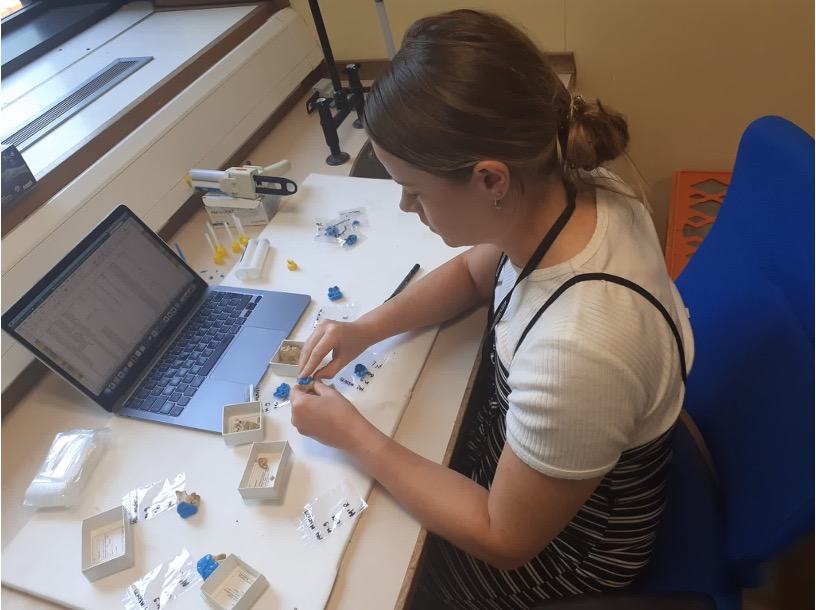
Conducting research at the Natural History Museum, London, June 2023. My research involved moulding the teeth of fossil deer species to reconstruct their diet using dental wear analysis.
How did you start writing for Scientia? What motivated you to do this?
I started writing for Scientia after discovering the platform during my PhD. I was looking for science writing opportunities that would allow me to combine my background in environmental research with my interest in communication. Scientia stood out because of its focus on making real research accessible to a broad audience, which is something I care deeply about.
I applied with writing samples and was thrilled to get the opportunity to write my first article. It was about a study on how COVID-19 affected the learning of remote, offshore students – a topic not directly related to my own research but one I could connect with due to having studied during the pandemic too. I enjoyed the challenge of turning technical content into a compelling narrative.
What motivated me was the chance to highlight important scientific work that might otherwise stay hidden in academic journals. As a researcher myself, I’ve seen how difficult it can be to explain the broader relevance of your work and to get wider audiences interested in your research too. Writing for Scientia allows me to help researchers share their findings with new audiences, and to do so in a way that’s accurate, engaging, and meaningful.
Over time, I’ve written about everything from palaeoecology and ecohydrological interactions to archaeology. Each article is a chance to learn something new and help others discover it too. I continue to write for Scientia because I love reading and learning about new science, and it also fulfils my passion for science education and communication. It’s rewarding to know that my writing can help amplify voices in research and connect people with similar interests.

Excavation in action! With my partner and fellow student Chloe Campbell. July 2025.
What have you learned from the articles you’ve written?
Each article I’ve written has taught me something – not just about the science itself, but about how to communicate ideas clearly, respectfully, and creatively. One of the biggest lessons has been how to translate complexity into clarity without losing the essence of the research.
I’ve learned how to spot the core message of a study quickly. For example, in an article I wrote on applying information theory to understand and quantify complex ecohydrological interactions, the paper itself was dense with equations, but after carefully filtering out the key messages, I found a way to explain the models in plain language. That became the heart of the article, and everything else was built around it.
Perhaps most importantly, I’ve deepened my understanding of science writing as a process. It’s not perfect, every assignment is different, and each one challenges me and helps me grow in various areas of skill and knowledge. Communicating that human side of science is something I’ve come to value deeply. I apply this learning not only to my current position as Scientific Content Producer at Technology Networks, but also in the academic papers I’m currently preparing for publishing myself. Writing for Scientia has made me a better writer, researcher, and communicator, and I’m proud to play a part in sharing science with the world.
SHARE

DOWNLOAD E-BOOK
REFERENCE
https://doi.org/10.33548/Issue155.3
REPUBLISH OUR ARTICLES
We encourage all formats of sharing and republishing of our articles. Whether you want to host on your website, publication or blog, we welcome this. Find out more
Creative Commons Licence (CC BY 4.0)
This work is licensed under a Creative Commons Attribution 4.0 International License. 
What does this mean?
Share: You can copy and redistribute the material in any medium or format
Adapt: You can change, and build upon the material for any purpose, even commercially.
Credit: You must give appropriate credit, provide a link to the license, and indicate if changes were made.
SUBSCRIBE NOW
Follow Us
MORE ARTICLES YOU MAY LIKE

Dr Haydee Laza | Identifying Aphidresistance to Protect Future Crops
Insect pests, such as aphids, are capable of decimating crop yields, leading to severe economic loss. Some plants, however, have developed traits that make them resistant to such pests. Identifying these traits in plants, however, is not simple. Dr. Haydee Laza from Texas Tech University has worked with colleagues to identify several sorghum aphidresistant leaf structure traits in sorghums. These traits can be used as the basis for developing future screening methods for identifying aphid resistance in sorghums, subsequently protecting future crop yields.

Dr. Colleen Fisher | Singing to the Lions: Tackling Childhood Trauma in Zimbabwe Through Creative Psychosocial Support
Mental health challenges are one of the biggest issues facing children and adolescents across the world, particularly in low-resource settings. In Zimbabwe, a 3-day intervention called Singing to the Lions is helping young people build resilience through creative, traumainformed workshops. Dr Colleen Fisher and colleagues in Zimbabwe and the U.S. led the first formal evaluation of the intervention, offering new insight into how locally grounded intervention approaches can support youth mental health at scale.
Dr Rhett Martin | Governing Nature at the Edge of Collapse
For millions of men, ageing brings with it a set of frustrating and often disruptive urinary symptoms. These symptoms, caused by benign prostatic hyperplasia, or BPH, can affect sleep, confidence, and overall quality of life. Traditionally, treatment follows a familiar path. Patients begin with medications, often for years, and may eventually progress to surgery if symptoms worsen. Yet this pathway is not without its drawbacks. Medications can cause side effects, while surgery carries risks and recovery time. In recent years, a minimally invasive interventional radiology procedure called prostate artery embolisation, or PAE, has begun to challenge this traditional model. At the forefront of this shift is a collaborative research group, led by Dr. Nicholas Brown of the University of Queensland, whose series of P-EASY studies has explored whether PAE could transform how BPH is treated, particularly at earlier stages.

Assoc Prof. Nicholas Brown | Rethinking Prostate Care: A New Frontier in Treating Benign Prostatic Hyperplasia
For millions of men, ageing brings with it a set of frustrating and often disruptive urinary symptoms. These symptoms, caused by benign prostatic hyperplasia, or BPH, can affect sleep, confidence, and overall quality of life. Traditionally, treatment follows a familiar path. Patients begin with medications, often for years, and may eventually progress to surgery if symptoms worsen. Yet this pathway is not without its drawbacks. Medications can cause side effects, while surgery carries risks and recovery time. In recent years, a minimally invasive interventional radiology procedure called prostate artery embolisation, or PAE, has begun to challenge this traditional model. At the forefront of this shift is a collaborative research group, led by Dr. Nicholas Brown of the University of Queensland, whose series of P-EASY studies has explored whether PAE could transform how BPH is treated, particularly at earlier stages.