
Dr Simone Farinelli – Dr Hideyuki Takada | Geometric Arbitrage Theory: A New Conceptual Structure in Financial Mathematics
Stochastic finance modelling allows researchers to describe, analyse, and predict the highly variable behaviour of markets. Dr Simone Farinelli (Core Dynamics GmbH, Switzerland) and Dr Hideyuki Takada (Toho University, Japan) are experts in mathematical finance and economics. They have developed a new conceptual structure known as the Geometric Arbitrage Theory that rephrases our understanding of classical stochastic finance modelling and allows the better characterisation of arbitrage in generic markets.
A Whistlestop Tour of Economics and Mathematical Finance
In the complex but fascinating field of economics and mathematical finance, researchers explore how financial instruments (assets) behave using theoretical models such as stochastic modelling calibrated with empirical data. In this context, a market is defined as a financial-economic system which can be modelled using principal fibre bundle theory, which has been heavily exploited in theoretical physics as the language in which laws of nature can be best formulated by providing an invariant framework to describe physical systems and their dynamics.
These ideas can be carried over to mathematical finance and gauge theories turn out to be the natural language to describe economics. By introducing an appropriate stochastic principle fibre bundle, a principle like the invariance of market laws under change of numéraire (i.e., the reference asset, like cash, for example) is formulated as gauge invariance. The asset’s cash flow bundles are represented by the associated vector bundle.
A market with N assets can be seen as an (N+1)-dimensional surface: the first dimension corresponds to the time and the remaining to the assets. The parallel transport of a portfolio along the timelines corresponds to discounting and inverse discounting; the parallel transport along the ‘space’ lines corresponds to multiplication by an exchange rate or portfolio rebalancing.
The No Arbitrage principle is loosely referred to as the No Free Lunch principle. An arbitrage strategy is a costless trading strategy (i.e., a mix of different asset classes which can vary over time) such that the probability of generating a positive return in every time step is always positive.
It turns out that a market is arbitrage-free, if and only if, the corresponding surface is a plane (i.e., it has no curvature). Positive curvature means a sure gain (arbitrage), and negative curvature is a sure loss (‘rip-off’). The curvature measures the instantaneous capability of generating arbitrage possibilities. Thus, the no-arbitrage principle has to be replaced by the minimal arbitrage principle for a closed market: the dynamics of the assets returns and of the market portfolio are such to minimise the total arbitrage generated by the market; in other words, the market forces are such that if somewhere at some point in time there is an arbitrage opportunity, somewhere else at some other time there must be a rip-off, and vice versa.

‘Can One Hear the Shape of a Drum?’
In 1966, the Polish-American mathematician Marc Kac posed the question, ‘Can one hear the shape of a drum?’. By this, he was asking whether we can use mathematical theory to deduce information about the shape of the drum from the sound it makes. Kac’s pioneering work was the starting point for decades of research into Geometric Spectral Theory – the study of the relationships between eigenvalues of linear operators like the Laplacian on a surface and the geometry of the surface itself. The parallel transport induces a derivation called connection on the cash flow bundle, whose Laplacian contains important arbitrage information.
The fundamental theorem of asset pricing implies that the market values of assets in a market model satisfying the No Free Lunch with Vanishing Risk (a stronger form of No Arbitrage) can be written as the expectation of their discount cash flows with respect to a probability measure termed risk neutral. If the risk-neutral measure is unique, the market is said to be complete.
The Relationship Between Arbitrage and Spectral Theory
The market model satisfies the No Free Lunch with Vanishing Risk condition if and only if the spectrum of the connection Laplacian under the Neumann boundary condition contains 0 and the harmonic sections of the cash flow bundle parameterise the change of measure from the statistical to the risk-neutral measures. The market is complete if and only if the multiplicity of 0 is simple.
If 0 is an eigenvalue, then the market admits no arbitrage strategies. The eigenvector corresponding to the lowest positive eigenvalue parametrises the change of measure from the statistical measure to the minimal arbitrage measure utilised to define the assets’ fundamental value, the best possible approximation to no-arbitrage values. The difference between market value and fundamental value is the asset bubble value. Fundamental values for call and put options satisfy the put-call parity even in the presence of arbitrage, while this is, in general, not true for the market values of the options.
The non-vanishing of the Euler characteristic of the space of nominals (i.e., the holdings in every asset class) is a topological obstruction for the No Free Lunch with Vanishing Risk condition.
While the work of Drs Farinelli and Takada builds on key concepts from financial mathematics, the incorporation of spectral theory represents a sophisticated and demonstrably valid tool with clear theoretical and practical application in finance.
SHARE

DOWNLOAD E-BOOK

REFERENCE
https://doi.org/10.33548/SCIENTIA1023
MEET THE RESEARCHER

Dr Simone Farinelli
Core Dynamics GmbH
Zurich
Switzerland
Dr Simone Farinelli holds a BSc in Physics and a BSc, MSc and PhD in Mathematics. In addition to this strong analytical background, Dr Farinelli has 25 years of experience in providing quantitative ALM solutions to banks, insurance companies, pension funds, and energy utilities, as well as pioneering scientific research to the risk community. He covers a broad variety of topics in financial and insurance risk management (including market, credit, country and insurance risks) with a focus on quantitative risk models and analytics, successfully establishing a bridge between cutting-edge research at the academic level and practical industrial implementations. He is an expert in delivering high-quality projects in fields such as financial risk, credit risk, risk aggregation with associated regulatory interactions, tactical and strategic asset allocation, as well as hedge strategies in banking treasury, institutional asset and fund management and the hedge fund context. Prior to co-founding Core Dynamics GmbH and joining as non-executive Council Director, Dr Farinelli worked several years for UBS, Zurich Cantonal Bank, Zurich Re, Winterthur Life Insurance and Profond Pension Fund.
CONTACT
E: simone@coredynamics.ch
W: https://www.coredynamics.ch/#/home
LinkedIn: https://www.linkedin.com/company/10878235

Dr Hideyuki Takada
Department of Information Science
Toho University
Chiba
Japan
Dr Hideyuki Takada obtained his BSc and MSc in Mathematics in 1997 and 1999, respectively. In 2011, he obtained his PhD in Engineering and has amassed 13 years of experience in quantitative risk management, covering diverse areas such as market, credit and liquidity risks. He has specialised in providing market and credit risk management techniques and trading strategies to Mizuho Bank and Mizuho Securities, with a particular focus on credit derivatives and collateralised debt obligations. In 2012, Dr Hideyuki took up his position at Toho University in Japan, where he continues to pursue theoretical research with a primary emphasis on credit risk management and the development of pricing models for credit-risky instruments, aiming to address practical challenges. His current research interests span the theoretical aspects of contagion phenomena, the application of machine learning techniques in the realm of mathematical finance, and the utilisation of differential geometry within the financial market.
CONTACT
E: hideyuki.takada@is.sci.toho-u.ac.jp
LinkedIn: https://www.linkedin.com/in/hideyuki-takada-64aa91214/?originalSubdomain=jp
FURTHER READING
S Farinelli, H Takada, Can You Hear the Shape of a Market? Geometric Arbitrage and Spectral Theory, Axioms, 2021, 10, 242. DOI: https://doi.org/10.3390/axioms10040242


REPUBLISH OUR ARTICLES
We encourage all formats of sharing and republishing of our articles. Whether you want to host on your website, publication or blog, we welcome this. Find out more
Creative Commons Licence (CC BY 4.0)
This work is licensed under a Creative Commons Attribution 4.0 International License. 
What does this mean?
Share: You can copy and redistribute the material in any medium or format
Adapt: You can change, and build upon the material for any purpose, even commercially.
Credit: You must give appropriate credit, provide a link to the license, and indicate if changes were made.
SUBSCRIBE NOW
Follow Us
MORE ARTICLES YOU MAY LIKE

Professor Gino Verleye – Wim Vermeulen | Credibility of Green Advertising: Six Elements That Drive Credibility in Green Advertising
Green advertising is becoming an increasingly important means of differentiation in modern markets. Organisations that can credibly communicate their environmental sustainability efforts are often better positioned to build trust and strengthen their competitive standing.
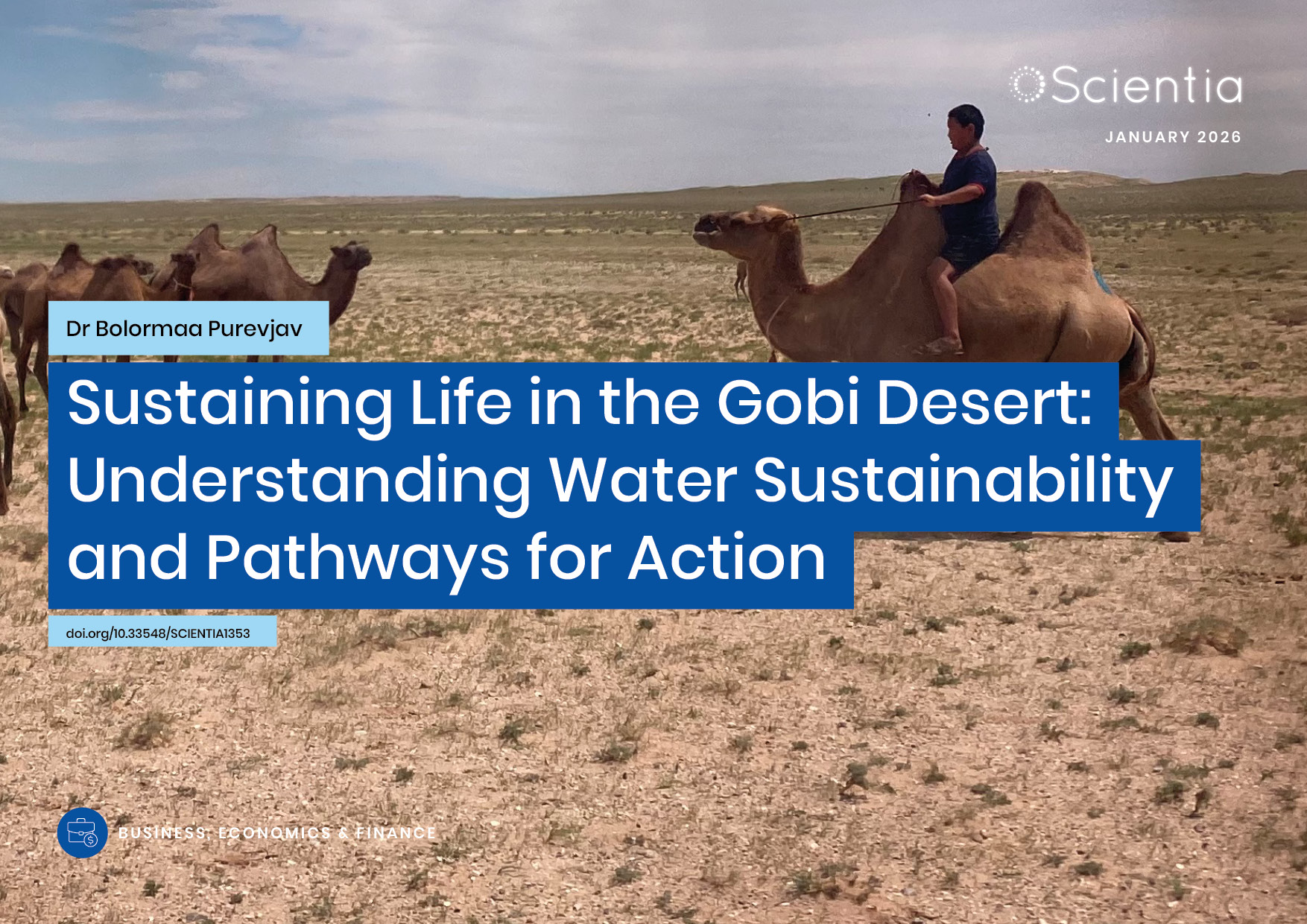
Dr Bolormaa Purevjav | Sustaining Life in the Gobi Desert: Understanding Water Sustainability and Pathways for Action
The mining industry plays a vital role in driving Mongolia’s economic growth and creating employment opportunities. However, in the Gobi Desert —one of the driest regions in Mongolia— water access, and community engagement remain critical challenges for the mining industry. In this region, water is a shared and scarce resource, relied upon by herders, towns, mining companies, wildlife, and fragile ecosystems alike.
A study by Dr Bolormaa Purevjav and her colleagues explored how a holistic approach which combines economic, social, and environmental principles called Integrated Water Resource Management (IWRM) can improve water sustainability in mining regions.

Dr Ariel Dinar – Dr Robert Mendelsohn | Agriculture in a Warming World: The Impact on the Future of Food
A major new scientific resource has been produced with the support of the Giannini Foundation of Agricultural Economics. Edited by Profs Ariel Dinar and Robert Mendelsohn, The Handbook on Climate Change Impacts, Adaptation, and Mitigation in Agriculture (Edward Elgar Publishing, May 2026) integrates evidence from empirical studies across five continents, providing one of the clearest pictures to-date of how climate change is influencing agriculture.
The studies range from large-scale econometric analyses to micro-level surveys, covering Africa, Europe, the United States, Brazil, China, and Mediterranean countries. The result is a body of work revealing scientifically rigorous patterns that are highly relevant for policy and practice. The foreword from Wolf Prize Laureate David Zilberman highlights how the Handbook’s findings are thematically organized into climate impacts, adaptation, mitigation, and governance.

Professor David Gerbing | A Quick and Easy New Way to Visualise Data
Do you find data analysis dense and impenetrable, like a quantitative jungle? You’re not alone. Many of the most useful statistical tools have steep-learning curves and often demand both sophisticated mathematical ability and advanced programming skills. But, in a world where data is constantly generated and recorded, it’s essential that data analysis tools are as accessible as possible. And there’s no reason they can’t be; with such powerful digital tools at our disposal, data visualisation can be made as straightforward as the click of a button.
That’s the goal behind Professor David Gerbing’s latest project – lessR. lessR is a free, open-source package for one of the most popular analysis programming languages, R, designed to make data visualisation as simple as possible. See Professor Gerbing’s written and video introduction to using the R language for data analysis at the website he provides for his students.